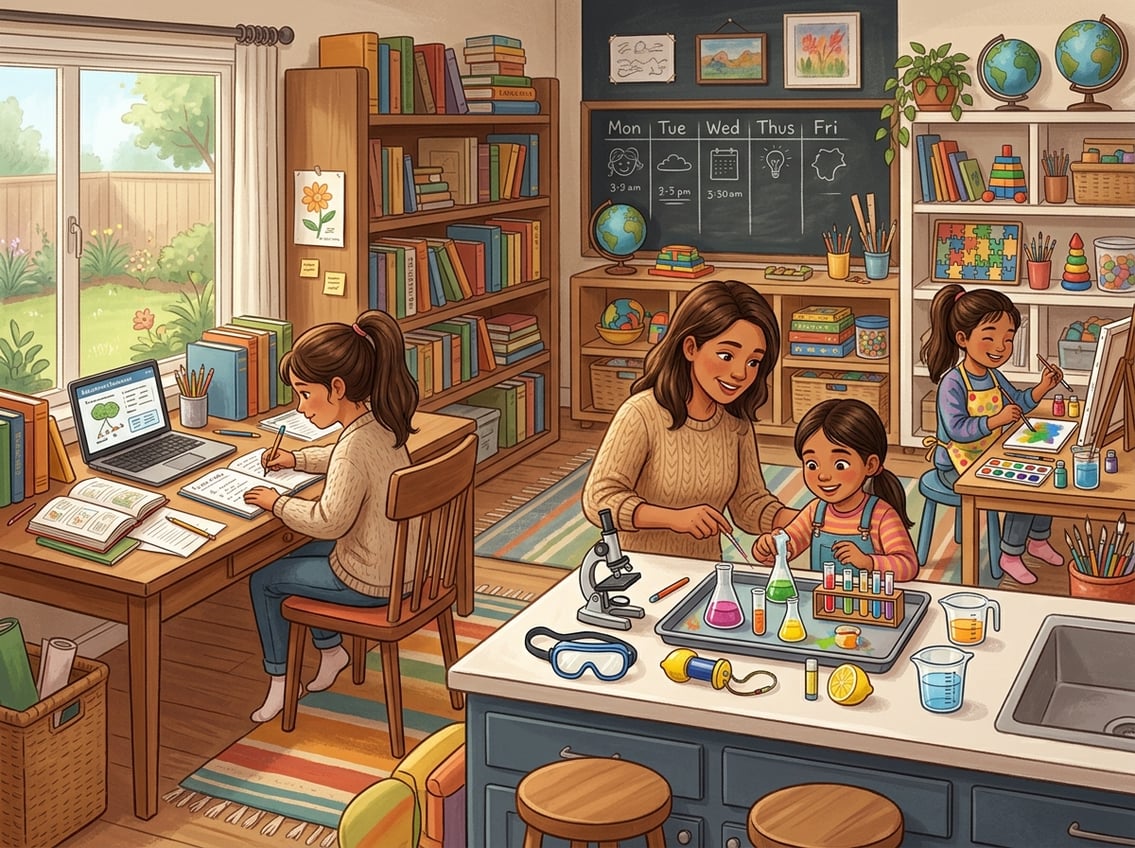
How The Day Usually Flows
Most homeschool families spend far fewer hours on formal academics than you might expect. The rhythm of the day tends to center on core subjects in the morning with looser learning woven into the rest of the day.
What Most Families Mean By Typical
When homeschooling families talk about a “typical” day, they rarely mean a rigid bell schedule. They mean a repeatable rhythm that gives the day some structure without mimicking a traditional classroom.
Your homeschool routine might follow a general flow: morning time together, focused lessons, a break, then independent work or projects. Some families follow a structured homeschool day with set times for each subject, while others use a flexible loop schedule and pick up where they left off the day before.
Both approaches count as “typical” because what matters is consistency, not rigidity.
How Long Formal Learning Usually Takes
One of the biggest surprises for new homeschool families is how little time formal instruction actually requires. According to experienced homeschool parents, elementary students often need only 1.5 to 2 hours of focused schoolwork per day, while middle schoolers typically need 3 to 4 hours.
High school students may spend 5 or more hours, especially if they are working through more demanding coursework. One-on-one instruction is simply more efficient.
You are not waiting for a class of 25 students to settle down. There is no time lost to hallway transitions, attendance, or busywork.
Your child gets direct teaching tailored to their pace.
Why Core Work Often Happens First
Most homeschool families tackle core academics like math, reading, and writing first thing in the morning. The reason is practical: your child’s focus and energy are usually highest early in the day.
Knocking out the hardest subjects while everyone is fresh means the rest of the day feels lighter. If something unexpected comes up in the afternoon, you already have the essentials covered.
This approach turns your homeschool schedule into something that protects priorities rather than fighting against the clock.
What Filling The Hours Actually Looks Like
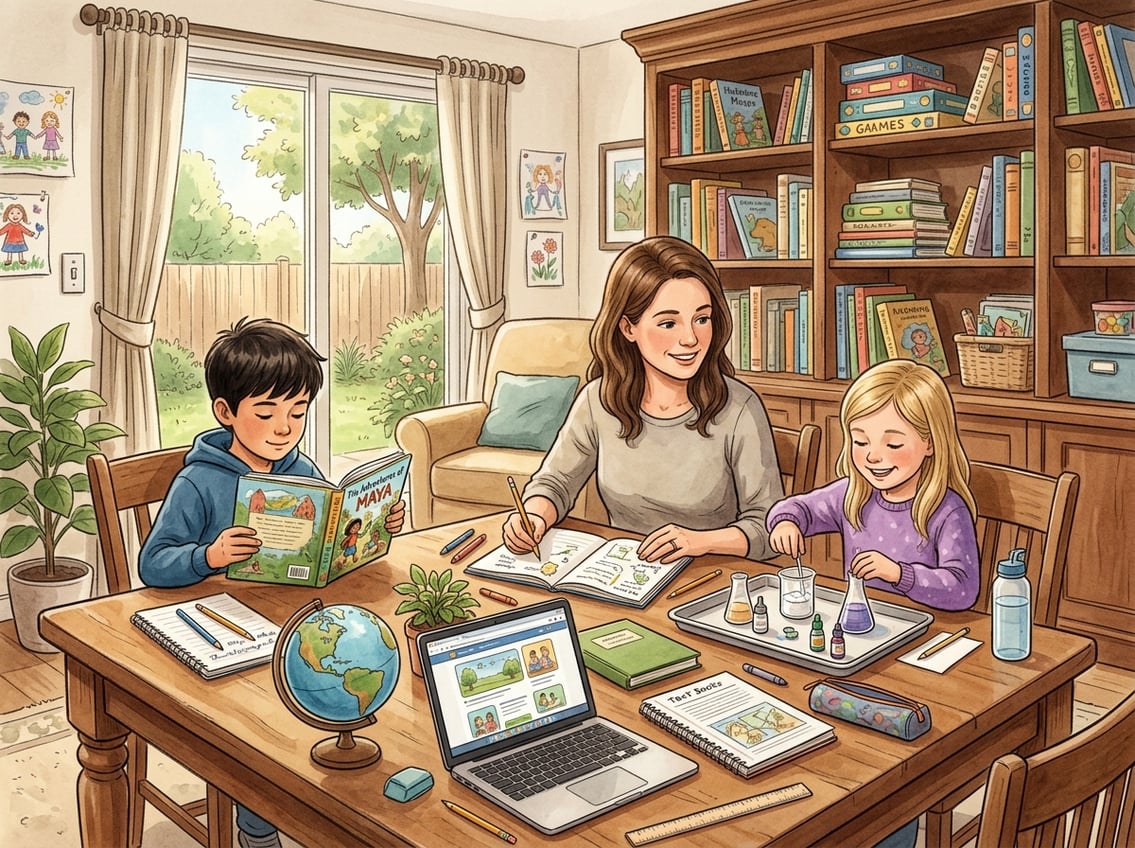
Beyond formal lessons, homeschool families fill the day with read-alouds, hands-on projects, nature exploration, and practical life skills. Everyday moments become real learning.
Morning Time, Read-Alouds, And Focused Lessons
Many homeschool families start the day with “morning time” or a family gathering. This is when you might read aloud from a living book, recite poetry, discuss a Bible passage, or review something from history together.
It sets a calm, connected tone before anyone opens a textbook. After morning time, you move into focused lessons.
This is where subjects like math, copywork, creative writing, and grammar get direct attention. Your child works one-on-one with you or follows an independent assignment at their level.
These focused blocks are usually the most structured part of the day. Read-alouds often continue beyond morning time, too.
Some families read aloud during lunch or at bedtime, weaving stories and discussions into the family’s rhythm.
Breaks, Independent Work, And Family-Style Learning
Breaks are not wasted time. They are essential.
Sending your kids outside to play for 20 or 30 minutes between subjects helps them reset and come back ready to focus. Independent work looks different depending on age.
An older child might read a history chapter and write a narration on their own. A younger child might practice handwriting or work through a simple math page while you help a sibling.
Family-style learning is a favorite strategy among homeschool families with multiple children. You study the same topic together, like a period in history or a nature study subject, but each child engages at their own reading level.
Then everyone comes together to discuss what they learned.
Afternoons For Projects, Nature, And Life Skills
Afternoons in most homeschool homes look nothing like a classroom. This is when handicrafts, science experiments, art projects, and nature study tend to happen.
You might take a walk to observe birds and sketch them in a nature journal. Your child might learn to cook a simple meal, fold laundry, or repair something around the house.
These are real life skills that matter. Many families also use afternoon hours for music practice, sports, or free reading.
This unstructured time is not wasted. It is where curiosity leads to deeper learning without a lesson plan attached.
Why No Two Homes Run The Same Way
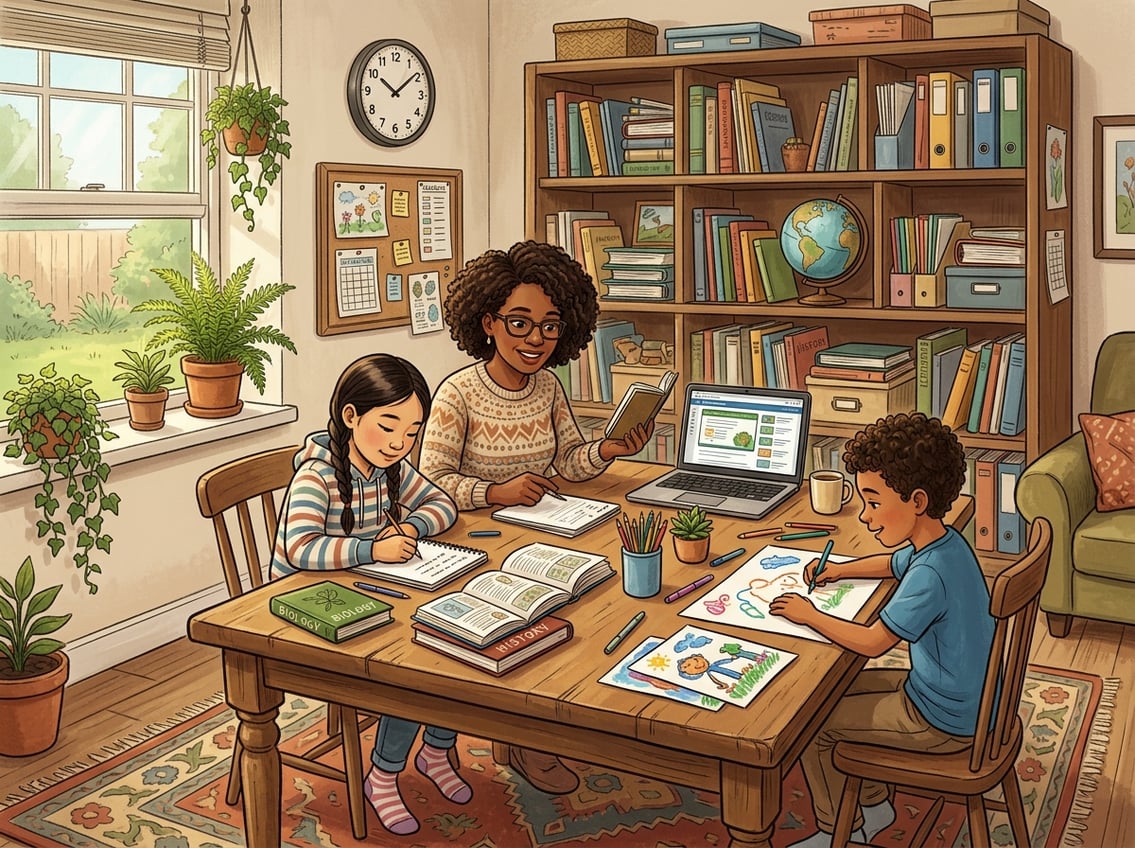
Your family’s ages, outside commitments, and educational philosophy all shape what your homeschool day looks like. No single template fits everyone.
Age, Independence, And Teaching Multiple Children
A five-year-old needs you sitting right beside them. A twelve-year-old can often manage a checklist of assignments independently.
When you are teaching multiple children, you quickly learn to stagger your time. Work directly with one child while another reads or completes independent practice.
Family-style subjects like history, science, and nature study help you teach everyone at once. Children can all study the same time period but read books at their own comprehension level and then come together to discuss.
Older children can also reinforce their own learning by helping younger siblings with reading or math facts.
Co-Ops, Outside Activities, And Off-Site Days
Many homeschool families participate in a homeschool co-op one day per week. Co-ops bring families together so kids can take group classes like science labs, drama, public speaking, or PE.
These days look completely different from a regular home day. Outside activities also shape your weekly schedule.
Your child might have a music lesson on Tuesday, a park day with other homeschoolers on Wednesday, and a sports practice on Thursday. Some families dedicate one full day to co-op and scatter individual classes throughout the week.
Your routine flexes around these commitments.
Flexible Approaches From Routine To Unschooling
Some families thrive with a detailed written schedule. Others prefer a loose rhythm where subjects happen in a general order but without fixed times.
Still others embrace unschooling, where the child’s interests and questions drive the learning rather than a set curriculum. Your routine depends on your kids’ ages, how many you are teaching, and what your everyday life looks like.
There is no single “right” way. The best homeschool day is one that fits your family.
Frequently Asked Questions
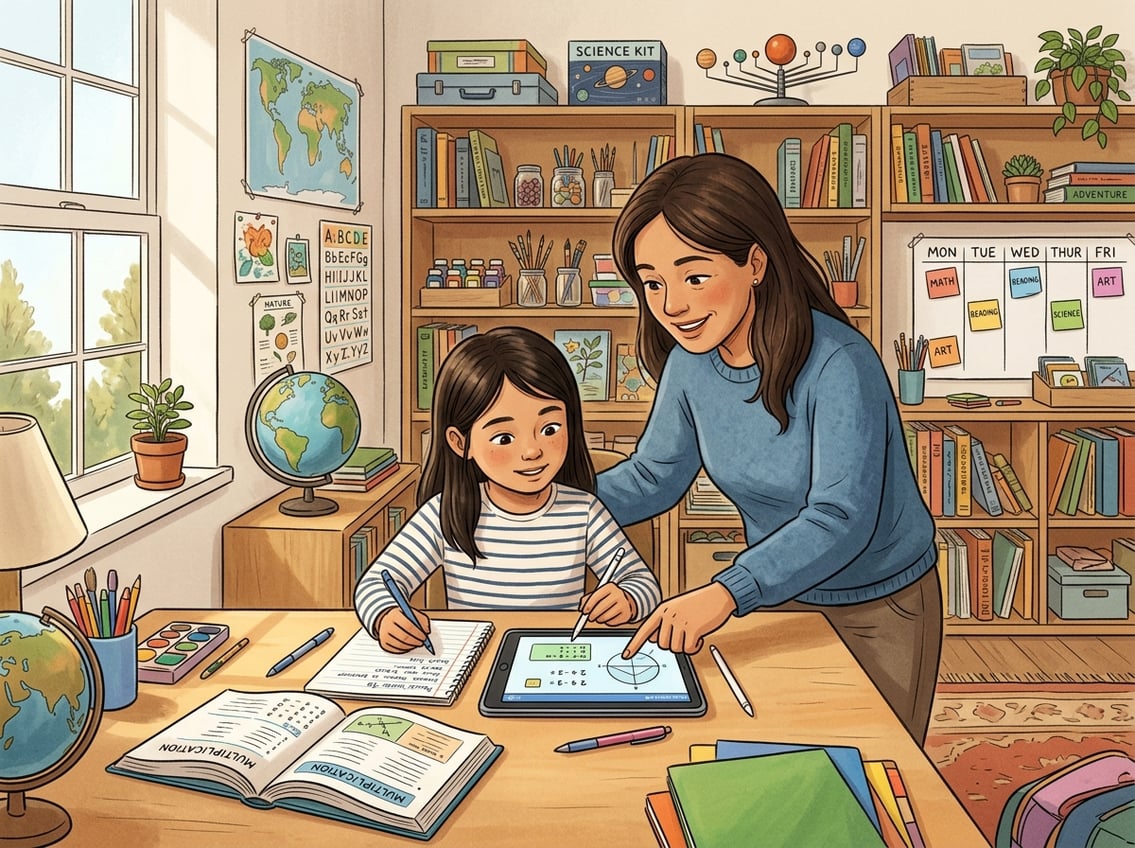
How many hours a day do families typically homeschool?
Most families spend between 2 and 5 hours on formal schoolwork each day, depending on the child’s grade level. Elementary-age children often finish in under 2 hours, while high schoolers may need 5 hours or more.
The total is much shorter than a traditional school day because one-on-one instruction eliminates time lost to transitions and classroom management.
What time do homeschoolers usually start and finish their school day?
There is no required start time. Many families begin formal lessons between 8:00 and 9:30 in the morning.
Younger students are often finished by late morning or lunchtime. High schoolers may work into the early afternoon.
Most families wrap up structured academics well before a traditional school day would end.
What does a typical homeschool schedule look like by grade level?
In the early grades, you might spend 30 minutes on math, 20 minutes on reading, and 15 minutes on handwriting or phonics before moving to read-alouds or play. Middle schoolers add subjects like writing, science, and history, filling 3 to 4 hours.
High schoolers often follow a more independent schedule with longer study blocks and elective coursework.
What does a homeschool day look like for kindergarten students?
Kindergarten homeschooling is short and play-based. You might spend 15 to 20 minutes on a phonics lesson, another 15 on a simple math activity, and then fill the rest of the morning with read-alouds, art, outdoor play, and hands-on exploration.
Formal instruction at this age rarely exceeds an hour.
How is a typical homeschool day different for high school students?
High schoolers take on more responsibility and independence. They often work from a checklist or syllabus, completing reading assignments, essays, and lab work on their own.
Some also attend co-op classes, take dual-enrollment college courses, or follow online curriculum, which adds structure and variety to their week.
How do families balance curriculum, breaks, and extracurriculars during the day?

Most families prioritize core subjects in the morning.
They schedule breaks between lessons.
Afternoons are often reserved for extracurriculars like sports, music, or co-op activities.
Building flexibility into your daily plan helps you adjust when unexpected events come up without losing momentum on important subjects.
Leave a Reply