What “Aligned To Standards” Actually Means At Home
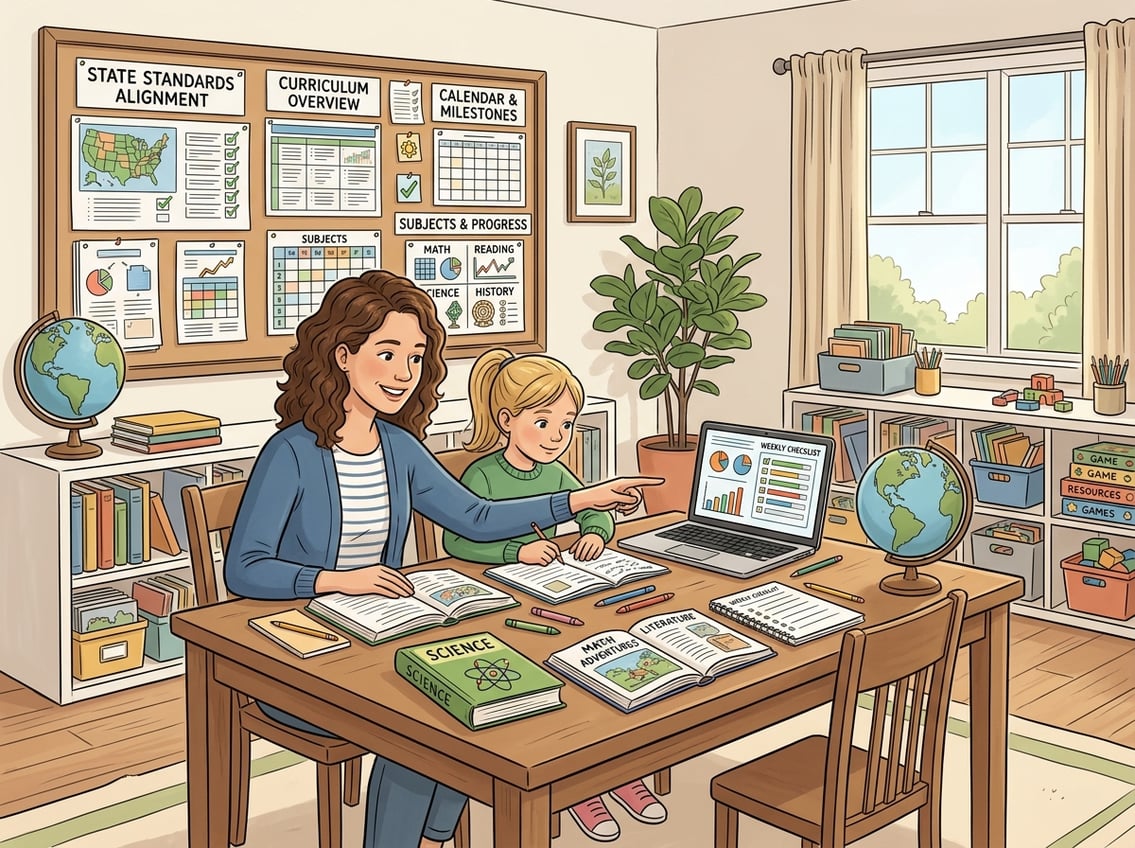
Standards alignment in homeschooling is not about turning your kitchen table into a public school classroom. It simply means using grade-level learning benchmarks as a flexible roadmap so you can feel confident your child isn’t missing key skills.
Think of standards as a checklist of destinations on a road trip, not the route you have to drive to get there.
The Difference Between State Standards And Curriculum
This is one of the most common points of confusion for homeschool families. State standards describe what your child should know and be able to do by the end of a grade level.
Your homeschool curriculum is how you teach those skills. For example, a third-grade math standard might say your child should understand fractions as parts of a whole.
You could teach that with a textbook, a pizza-cutting activity, or a baking lesson. The standard stays the same; the curriculum is entirely your choice.
As noted in this overview of standards alignment for homeschoolers, standards are a guide for what to learn, not a script for how you teach.
Your homeschooling curriculum can look wildly different from what a public school uses and still cover the same ground.
Common Core vs. State Standards vs. NGSS
You will hear these terms tossed around a lot. Here is a quick breakdown:
- Common Core State Standards (CCSS or CCS): A shared set of K-12 benchmarks in English language arts and math, adopted (and often modified) by many states.
- State-specific standards: Each state can adopt, revise, or completely replace Common Core with its own standards. Some states, like Texas and Virginia, never adopted Common Core at all.
- Next Generation Science Standards (NGSS): A separate set of science standards focused on hands-on investigation and real-world application. Not every state uses NGSS; some have their own science frameworks.
The best place to find your state’s exact requirements is your state’s department of education website. Search for “[your state] academic standards” and you will find the documents organized by grade and subject.
Why Alignment Does Not Mean Copying Public School
This is the part that trips up many new homeschooling parents. Aligning to standards does not mean you need to use the same textbooks, follow the same daily schedule, or assign the same worksheets as your local school district.
It means you are checking that the skills and concepts your child learns match what is generally expected at their age. You still get full freedom to choose your teaching methods, your pace, and your materials.
A customized education is the whole point of homeschooling. Standards alignment just gives you a safety net to make sure nothing important falls through the cracks.
Choose Your Learning Targets Before You Choose Materials

One of the biggest mistakes you can make is picking a shiny curriculum first and then hoping it covers everything your child needs. Flip the process around.
Start by identifying what your child should learn this year, then find or build materials that match those learning objectives.
Using Learning Objectives To Define ‘On Track’
Learning objectives are the specific, measurable skills you want your child to master. Instead of a vague goal like “get better at reading,” a learning objective sounds like “read and understand grade-level fiction and nonfiction texts independently.”
Pull these objectives directly from your state’s standards documents. Write them down in plain language you actually understand.
Once you have a clear list, you have a concrete definition of what “on track with peers” really means for your child this year.
For practical starting points, reviewing your child’s grade-level academic standards gives you specific targets and measurable checkpoints that make tracking progress much easier.
How To Build A Simple Scope And Sequence
A scope and sequence sounds fancy, but it is just a plan that answers two questions: What are we covering? (scope) and In what order? (sequence).
Here is a simple way to build one:
- List the major subjects you need to cover (math, language arts, science, social studies).
- Under each subject, write the key learning objectives for the year from your state standards.
- Spread those objectives across your school months or terms.
- Leave buffer weeks for review, deep dives, or topics your child gets excited about.
You do not need specialized software. A spreadsheet, a notebook, or even a set of index cards works.
The goal is a birds-eye view of your year so you know where you are headed and can adapt as needed.
This approach supports personalized learning because you are building the plan around your child, not around a publisher’s timeline.
When To Follow Grade Level And When To Adjust
Grade levels are guidelines, not rules. If your child is reading two years ahead but struggling with multiplication, there is no reason to force both subjects into the same grade-level box.
That flexibility is one of the greatest strengths of homeschooling. Use grade-level standards as a starting reference point.
Then adjust based on your child’s actual abilities and learning styles. A child who learns best through hands-on projects might need more time on a concept but will retain it far longer than a child who memorized it for a test.
The one exception: if you anticipate your child returning to a traditional school, keeping core subjects close to grade level in math and reading makes that transition smoother.
How To Match Your Current Resources To State Expectations
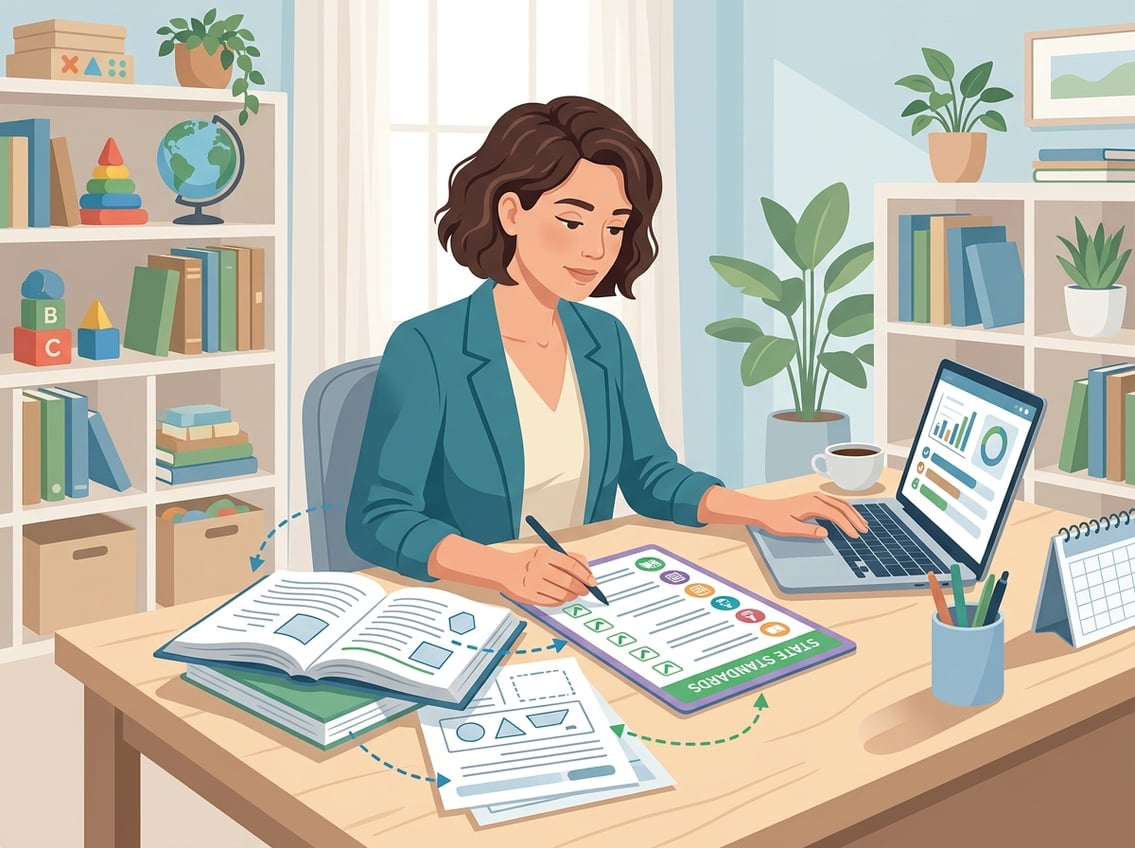
You do not need to toss out everything you already own and start fresh. Most homeschool families already cover more standards than they realize.
The key is doing a quick audit to find out what is covered, what is partially covered, and what needs a little extra attention.
Auditing A Complete Program For Coverage
If you are using an all-in-one boxed curriculum, check the publisher’s website first. Many programs, like those described in this curriculum planning checklist, include a scope and sequence document or even a standards correlation chart.
Pull up your state standards side by side with your curriculum’s table of contents. Go subject by subject and check off each standard that your program addresses.
Mark any gaps you find. Often, the gaps are small and easy to fill with a library book, a short online unit, or a hands-on project.
You are not looking for a perfect one-to-one match. You are looking for reasonable coverage of the major skills and concepts.
Aligning Eclectic Resources And Unit Studies
Eclectic homeschool families piece together resources from multiple sources. This is completely valid, but it requires a bit more intentional tracking.
Here is a practical approach:
- Create a simple chart with your state standards listed in one column.
- As you complete a unit study, a read-aloud, or an activity, note which standards it touched in the next column.
- At the end of each quarter, review the chart to see what has been covered and what still needs attention.
Unit studies are especially powerful because a single project on, say, ancient Rome can cover reading, writing, history, geography, art, and even math if you work in timelines and measurements.
You select materials that capture key learning objectives while letting your child’s curiosity drive the experience.
Making Room For Interest-Led Learning And Unschooling
If your approach leans toward unschooling or interest-led learning, standards alignment might feel like it goes against everything you believe in. It does not have to.
Think of standards as a background reference, not a daily agenda. Let your child follow their passions, then periodically check which standards their self-directed learning has naturally covered.
A child obsessed with dinosaurs is learning science, reading nonfiction, building vocabulary, and possibly doing math when they compare sizes and timelines.
Keep a simple log of activities and the skills they develop. You will likely be surprised at how much ground interest-led learning covers on its own.
Where genuine gaps appear, you can gently introduce targeted activities without derailing the joy of discovery.
Tracking Progress Without Losing Flexibility
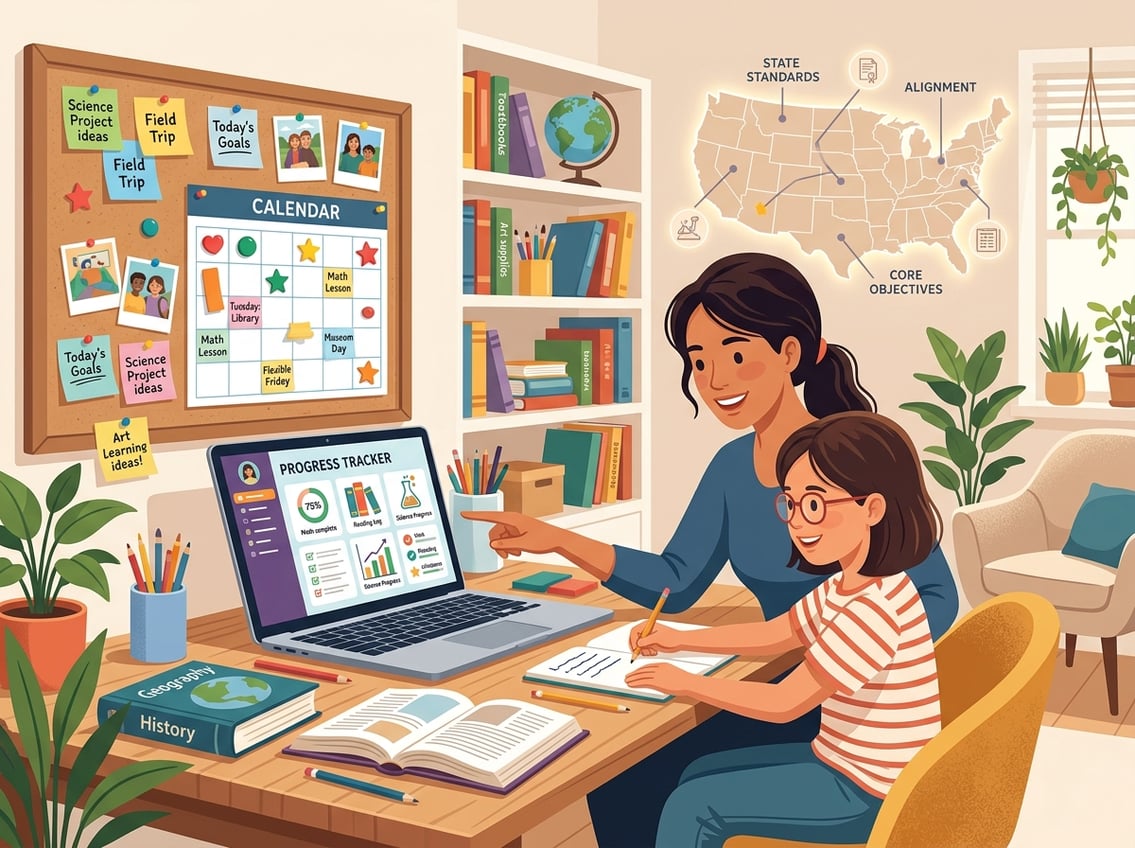
Tracking does not mean testing every week or filling out mountains of paperwork. It means keeping enough records to show your child is learning and growing, while preserving the freedom that makes homeschooling work for your family.
Simple Ways To Document Mastery
You have plenty of options beyond traditional grades. Consider these low-stress approaches:
- Portfolio: Collect samples of your child’s work throughout the year. Writing samples, art projects, math worksheets, photos of science experiments, and book lists all count.
- Checklists: Print your state standards and simply check them off as your child demonstrates understanding. No formal test required.
- Narration and discussion: After a lesson or reading, have your child explain what they learned in their own words. Jot a quick note about what they said.
- Digital tools: Apps like HomeTrail help you log attendance, plan activities, and build records your state may require.
The goal is to create a simple, consistent habit. Even five minutes of note-taking at the end of each day adds up to a powerful record over time.
As outlined in this guide to tracking homeschool hours and progress, you do not need complicated systems to stay organized.
How Alignment Helps With Standardized Tests
Some states require standardized tests for homeschoolers. Even if yours does not, you might choose to test your child periodically to get an objective snapshot of their progress.
When your curriculum is aligned to state standards, standardized tests hold far fewer surprises. Your child will have been exposed to the types of problems, vocabulary, and concepts these tests assess.
This does not mean you need to “teach to the test.” It means the natural coverage of grade-level skills gives your child a solid foundation for whatever test they encounter.
If testing is optional in your state, consider doing it every year or two just for your own peace of mind. It is one data point among many, not the final word on your child’s abilities.
Preparing For A Possible Return To School
Life is unpredictable. A job change, a family move, or your child’s own request might lead to enrolling in a traditional school someday.
Standards alignment makes this transition dramatically easier. When your child’s skills match grade-level expectations in core subjects, placement decisions are straightforward.
Bring your portfolio, any test scores, and your scope and sequence to the enrollment meeting. Schools appreciate seeing organized documentation of what your child has covered.
Even if a return to school is not on your radar right now, keeping good homeschool records protects you legally and sets your child up for success no matter what path they choose later.
Frequently Asked Questions
How do I find the state standards for my child’s grade level and subject?
Go to your state’s department of education website and search for “academic standards” or “learning standards.” Most states organize them by grade level and subject, with downloadable PDF documents.
You can also search “[your state name] grade [number] standards” for direct results.
What’s the easiest way to map my homeschool curriculum to state standards without rewriting everything?
Place your curriculum’s table of contents or scope and sequence next to your state’s standards list and look for overlap. Check off each standard your materials already address.
For any gaps, add a targeted activity or resource rather than replacing your entire program. Starting with the standards and mapping backward to your existing lessons is an efficient approach.
How can I check whether my child is on track with peers if we’re using a different curriculum?
Use a combination of periodic standardized tests, portfolio reviews, and grade-level benchmark checklists from your state. These tools give you an objective picture of where your child stands compared to typical grade-level expectations.
What documentation should I keep to show progress aligned to standards, especially in New York State?
New York requires an Individualized Home Instruction Plan (IHIP), quarterly reports, and an annual assessment (either a standardized test or a written narrative evaluation by a certified teacher). Keep dated work samples, attendance logs, and your IHIP on file.
Having a portfolio organized by subject makes quarterly reporting much simpler.
What are the required homeschooling steps in NYS (like the letter of intent and yearly plan) and how do they connect to standards?
In New York State, you must file a Letter of Intent with your local school district. Submit an IHIP listing the subjects and materials you plan to use.
Provide quarterly reports showing progress and complete an annual assessment. Your IHIP should reference the subjects NYS requires at your child’s grade level, which are tied to the state’s learning standards.
How do NYS homeschool requirements differ by grade level, including kindergarten and high school?
Kindergarten through sixth grade requires instruction in specific subjects like math, reading, science, social studies, music, art, and physical education.
Grades seven and eight add health, career education, and a few other subjects.
High school requirements become more specific because students need to accumulate units of study (credits) in required subjects to earn a diploma or equivalency.
Leave a Reply