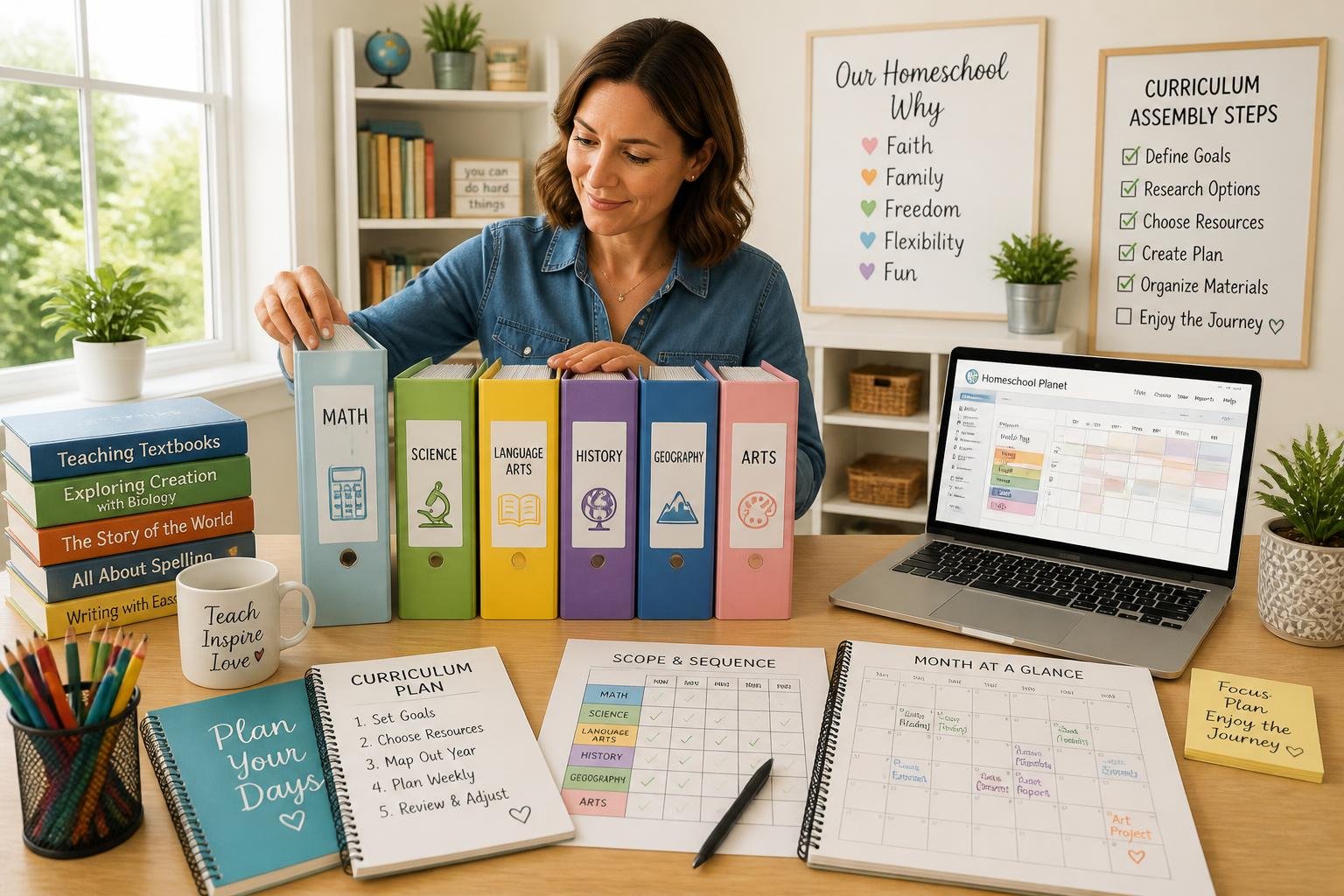
Choose Your Framework Before You Pick Resources
Before buying a single textbook or signing up for any online courses, families need a clear framework that guides every decision that follows. The most effective homeschool curriculums start with purpose, not products.
A well-chosen framework shapes the daily rhythm, the types of materials used, and how progress gets measured across the year.
Define Your Goals, Family Rhythm, and Reasons for Homeschooling
Every family homeschools for different reasons. Some want more flexibility.
Others want a faith-centered education or need to accommodate a child’s unique learning pace. Writing down those reasons helps keep the curriculum aligned with what actually matters.
It also helps to think about the family’s daily rhythm. A household with a parent who works from home part-time will look different from one with a stay-at-home parent available all day.
Setting realistic expectations early prevents burnout and keeps the schedule sustainable.
Pick a Teaching Approach That Fits Your Child
Homeschooling offers a wide range of teaching philosophies, and each one shapes what a typical day looks like. Some popular approaches include:
- Charlotte Mason focuses on living books, nature study, and short lessons.
- Montessori emphasizes hands-on, self-directed learning.
- Unschooling follows the child’s interests with minimal formal structure.
- Unit studies organize learning around a single theme across multiple subjects.
- Eclectic homeschool blends elements from several methods.
Parents should observe how their child learns best. A child who thrives with movement and tactile activities may do well with a Montessori-inspired approach, while a bookworm might gravitate toward a Charlotte Mason style.
As noted by the Coalition for Responsible Home Education, home educators often rely on purchased curriculum for some subjects while creating their own learning experiences for others.
Use Standards as Reference Points, Not Rigid Rules
State learning standards like Common Core or Next Generation Science Standards can serve as helpful benchmarks. They show what skills and knowledge are generally expected at each grade level.
Families do not need to follow them line by line, but reviewing them helps identify gaps and ensures children stay on track for future transitions into traditional school settings if needed. Many states also have specific homeschool requirements.
Checking those before building anything prevents headaches later.
Decide What to Teach at Home and What to Outsource
Not every subject needs to be parent-taught. Some families outsource subjects like foreign languages, advanced math, or lab sciences through online courses, co-ops, or community college classes.
This is especially common as children reach high school. Being honest about personal strengths and limitations makes the whole plan stronger.
A parent who loves literature but struggles with algebra might teach language arts at home and use an online platform for math.
Assemble Your Curriculum Subject by Subject
Once the framework is in place, families can start selecting actual materials for each subject. The key is to pick resources that serve specific learning goals rather than grabbing whatever looks popular.
A strong homeschool curriculum combines core academics with room for exploration and personal interests.
Map Core Subjects Into Teachable Yearly Goals
Start by listing the core subjects: language arts, math, science, social studies or history, and any required subjects in the family’s state. For each one, write down three to five big goals the child should reach by the end of the year.
These goals do not need to be complicated. For a third grader, a math goal might be “master multiplication facts through 12” and a reading goal might be “read 20 chapter books independently.”
Yearly goals act as a roadmap and make it easier to measure progress.
Build Language Arts With Separate Skill Strands
Language arts covers a lot of ground, so it helps to break it into individual strands:
- Phonics and reading (for younger learners)
- Spelling
- Grammar and writing mechanics
- Composition and creative writing
- Literature and read-aloud time
Families do not need one boxed curriculum to cover all of these. Many experienced homeschoolers mix and match.
They might use a structured phonics program, a separate spelling workbook, and living books for literature. This approach lets parents customize each strand to the child’s current skill level.
Choose Math, Science, and History Resources With Purpose
For math curriculum, the choice often comes down to mastery-based programs (which teach one concept deeply before moving on) versus spiral programs (which revisit concepts throughout the year).
Free resources like Khan Academy can supplement or even serve as the primary math instruction for some families. Science can be taught through textbooks, experiments, virtual field trips, or project-based learning.
Many families find that hands-on science sticks better than reading from a textbook alone. History curriculum varies widely.
Some families prefer a chronological approach using living books and primary sources. Others use a Charlotte Mason-inspired method with narration and timeline work.
The important thing is choosing an approach that makes history feel relevant and engaging rather than like a list of dates.
Add Enrichment, Electives, and Interest-Led Learning
A complete education goes beyond core academics. Enrichment subjects bring variety and keep children excited about learning.
Some ideas include:
- Art, music, or drama
- Physical education or organized sports
- Foreign languages
- Coding or technology
- Life skills like cooking, budgeting, or gardening
Interest-led learning is one of homeschooling’s biggest advantages. If a child becomes fascinated with marine biology or architecture, families can weave that interest into science, math, and even writing assignments.
Clever Homeschool frequently highlights how unit studies can connect a single topic across multiple subjects, turning a child’s curiosity into deep, meaningful learning.
Turn Materials Into a Flexible Weekly Plan
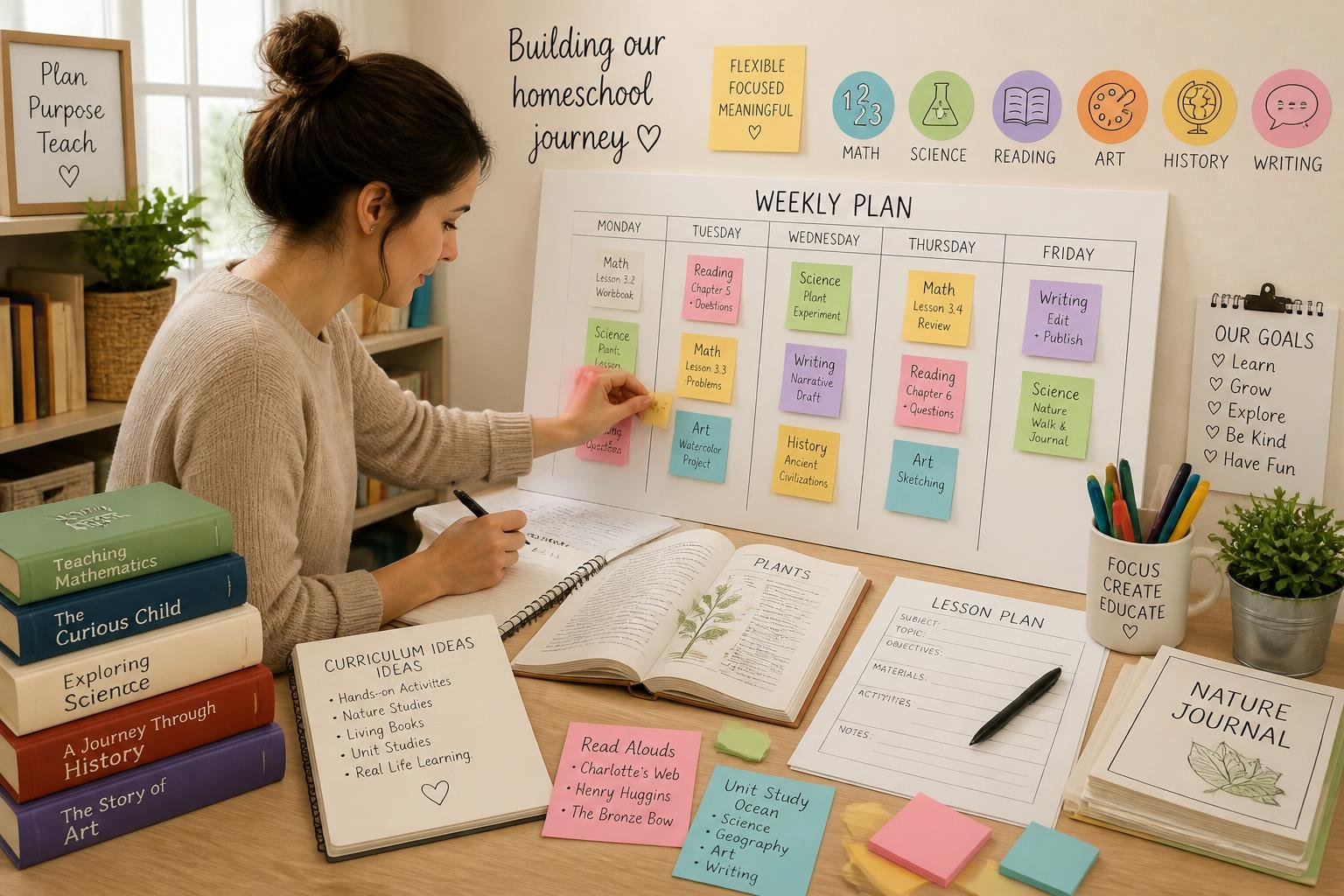
Having great resources means little without a workable plan to use them. The goal is to create a structure that keeps the family on track without making every day feel rigid.
Flexibility is one of homeschooling’s greatest strengths, and a good weekly plan preserves that.
Create a Simple Scope and Sequence
A scope and sequence is just a fancy term for an outline of what will be taught and when. It does not need to be a 40-page document.
A simple spreadsheet or chart works well. List each subject down one side and the months or weeks across the top.
Then fill in the major topics or units for each time period. For example, a history scope and sequence might look like:
| Month | History Topic |
|---|---|
| September | Ancient Egypt |
| October | Ancient Greece |
| November | Ancient Rome |
| December | Review and projects |
This gives the year a shape without locking families into an inflexible day-by-day schedule.
Build Weekly Lesson Plans That Leave Room for Real Life
Weekly lesson plans work better than daily ones for most homeschooling families. They allow for sick days, field trips, and those moments when a child needs extra time on a concept.
A basic weekly plan might include:
- Math: 4 lessons per week, 30 minutes each
- Language arts: Daily reading plus 3 writing or grammar sessions
- Science: 2 sessions per week with one hands-on activity
- History: 2 sessions per week with living books or videos
- Enrichment: 2-3 sessions per week for electives and interests
Some families prefer a loop schedule, where subjects rotate rather than being assigned to specific days. This keeps everything moving forward even when the week does not go as planned.
Use a Homeschool Planner to Track Progress and Records
A homeschool planner, whether digital or paper, helps families stay organized and creates a record of what was accomplished. Many states require some form of documentation, so tracking attendance, subjects covered, and materials used is practical and sometimes legally necessary.
Good planners include space for:
- Weekly lesson assignments
- Books and resources used
- Notes on the child’s progress
- Attendance or hours logged
According to the Homeschool Start Guide, mapping out grade-level goals and building a weekly schedule are essential steps in creating a curriculum from scratch. Free printable templates and digital planning tools make this process much simpler than it used to be.
Review, Revise, and Transition Without Starting Over
No curriculum plan survives the entire year unchanged, and that is perfectly fine. Families should plan to review their approach every few months.
If a math program is causing daily frustration, it might be the wrong fit. If a child races through a reading curriculum, they may need more challenging material.
The beauty of a self-built curriculum is that adjustments do not require scrapping everything. Families can swap out one resource, shift the schedule, or change the teaching method for a single subject while keeping everything else in place.
As the Coalition for Responsible Home Education points out, if a child develops an interest in a particular area, parents have the freedom to go deeper or shift direction as new resources are found.
Frequently Asked Questions
How do I figure out what subjects and skills my child needs at their grade level?
State learning standards are a great starting point. Most states publish grade-level expectations for math, reading, writing, science, and social studies online for free.
Families can use these as a checklist to identify what skills to focus on, even if they choose not to follow them exactly.
What steps should I follow to plan a full year of homeschool lessons and schedule them?
Start by defining yearly goals for each subject. Then create a simple scope and sequence that maps topics to months or quarters.
Break that down into weekly lesson plans, and use a homeschool planner to assign tasks and track what gets done. Keeping plans flexible makes them easier to stick with.
How can I choose resources and materials without spending a lot of money?
Libraries, free online platforms like Khan Academy, open educational resources, and used curriculum sales are all budget-friendly options. Many families mix free resources with one or two purchased programs for subjects that need more structure.
Buying used books and swapping materials with other homeschool families also keeps costs low.
What are some simple examples or templates I can use to structure my curriculum?
A basic weekly grid listing subjects and daily tasks works well for most families. Many homeschool bloggers offer free printable lesson plan templates that include space for goals, assignments, and notes.
A spreadsheet with subjects, weekly topics, and resources used is another simple option.
How do I make sure my homeschool plan meets my state’s legal requirements?
Each state has different homeschool laws. Some require notification, standardized testing, or portfolio reviews.
Families should check their state’s department of education website or a trusted homeschool legal organization for specific requirements before building their plan. Keeping thorough records of attendance, subjects taught, and materials used helps meet most state guidelines.
How can I track progress and adjust the curriculum if my child is ahead or struggling?
Regular check-ins, such as informal quizzes or portfolio reviews, help parents gauge where a child stands.
If a child is ahead, they can move to more challenging material or explore a topic in greater depth.
If they are struggling, slowing down or trying a different teaching method can help.
Switching to a new resource for that subject may also be beneficial.
Leave a Reply