What Makes A Curriculum Work Across Multiple Ages
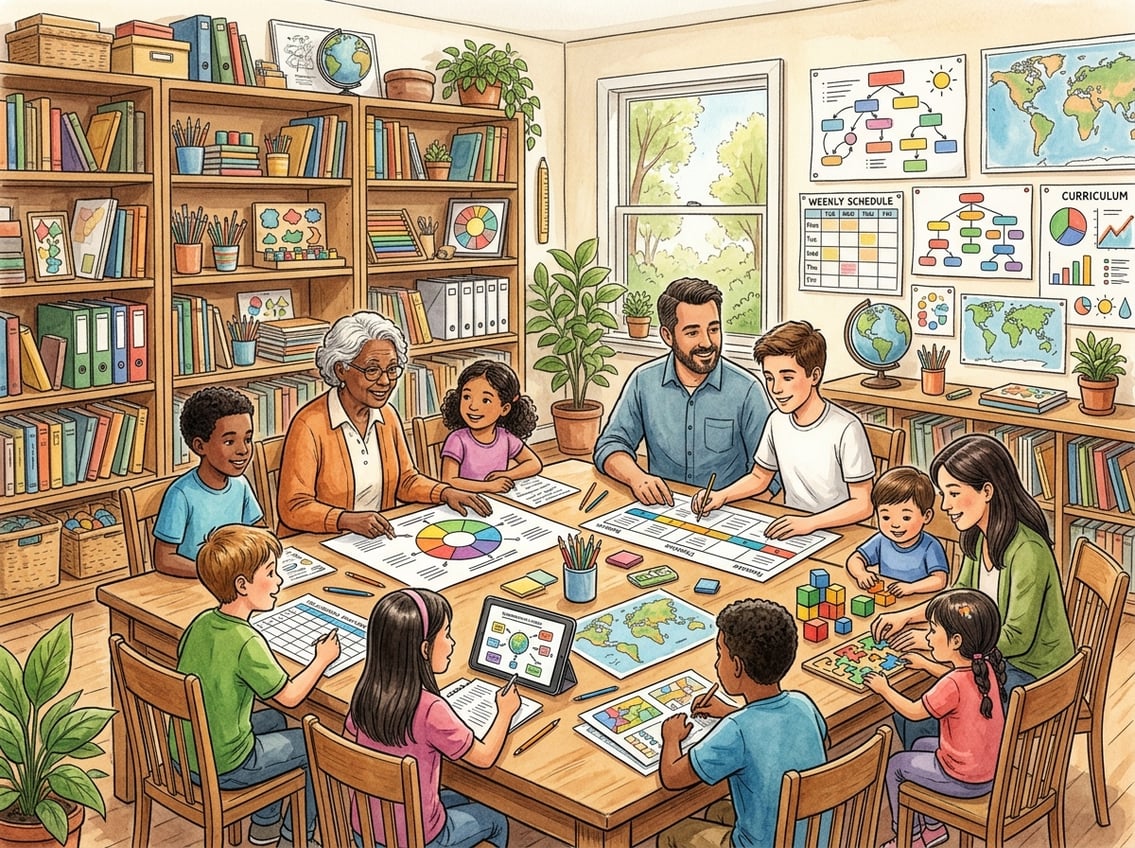
A strong family-style homeschool curriculum saves you time, keeps your budget sane, and brings your kids together around shared learning experiences. The best programs share a few key traits: they use content everyone can access, they scale naturally by age, and they focus on subjects where group discussion actually deepens learning.
Core Traits Of A Strong Family-Style Program
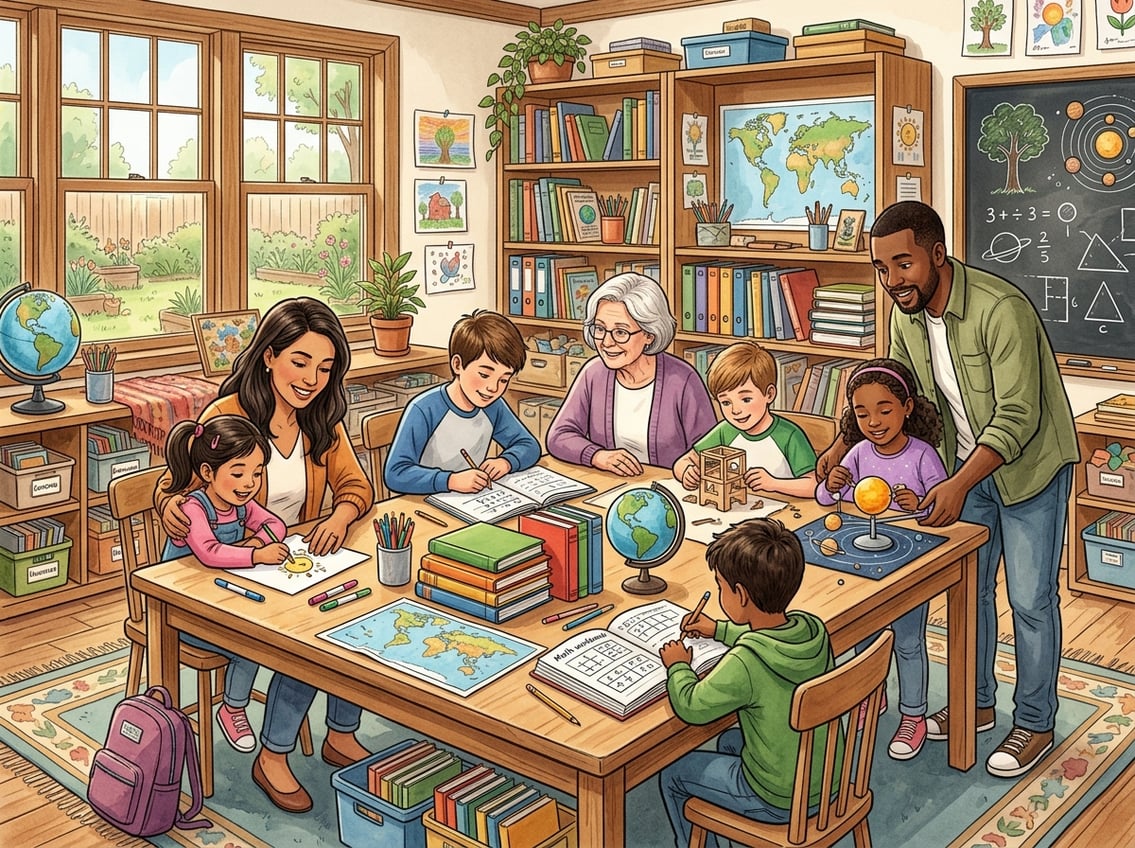
The single most important feature of any family-style homeschool curriculum is that it teaches one topic to all your kids at the same time, then adjusts expectations by age. You read one book aloud, do one experiment, or watch one documentary together.
Your younger kids narrate what they learned. Your older kids write essays or complete research projects.
Look for programs that include:
- A single teacher’s guide covering multiple grade levels
- Hands-on activities that naturally involve different skill levels
- Living books or real-world materials instead of dry textbooks
- Flexible pacing so you can spend extra time on topics your family loves
The best homeschool methods for multi-age teaching, like unit studies and Charlotte Mason, were practically designed for this. They treat learning as a conversation, not a conveyor belt.
Best Subjects To Combine In A Multi-Age Home
History and science are the sweet spots for family-style learning. A five-year-old and a twelve-year-old can both study ancient Egypt or the water cycle.
They just engage at different depths.
Other strong candidates for combining include:
- Geography and culture studies
- Art and music appreciation
- Nature study and outdoor exploration
- Read-aloud literature
These subjects rely on exposure, curiosity, and discussion. Your kindergartner absorbs more than you think when they sit in on a lesson about the Civil War or watch a chemistry demonstration.
The key is picking content-rich subjects where there’s no strict prerequisite chain.
When Separate Math And Language Arts Still Make Sense
If you’re learning how to homeschool multiple children, you’ll quickly realize that math and language arts almost always need to stay individual. A second grader working on addition facts and a seventh grader tackling pre-algebra are simply in different worlds.
Reading instruction, phonics, spelling, and grammar also depend heavily on your child’s current skill level. Trying to teach these in a group usually frustrates everyone.
Spend your morning doing family-style history, science, or read-alouds together. Then rotate through individual math and language arts sessions in the afternoon.
This gives you the efficiency of group learning where it works and the precision of one-on-one teaching where it matters.
Choosing By Teaching Philosophy And Family Fit
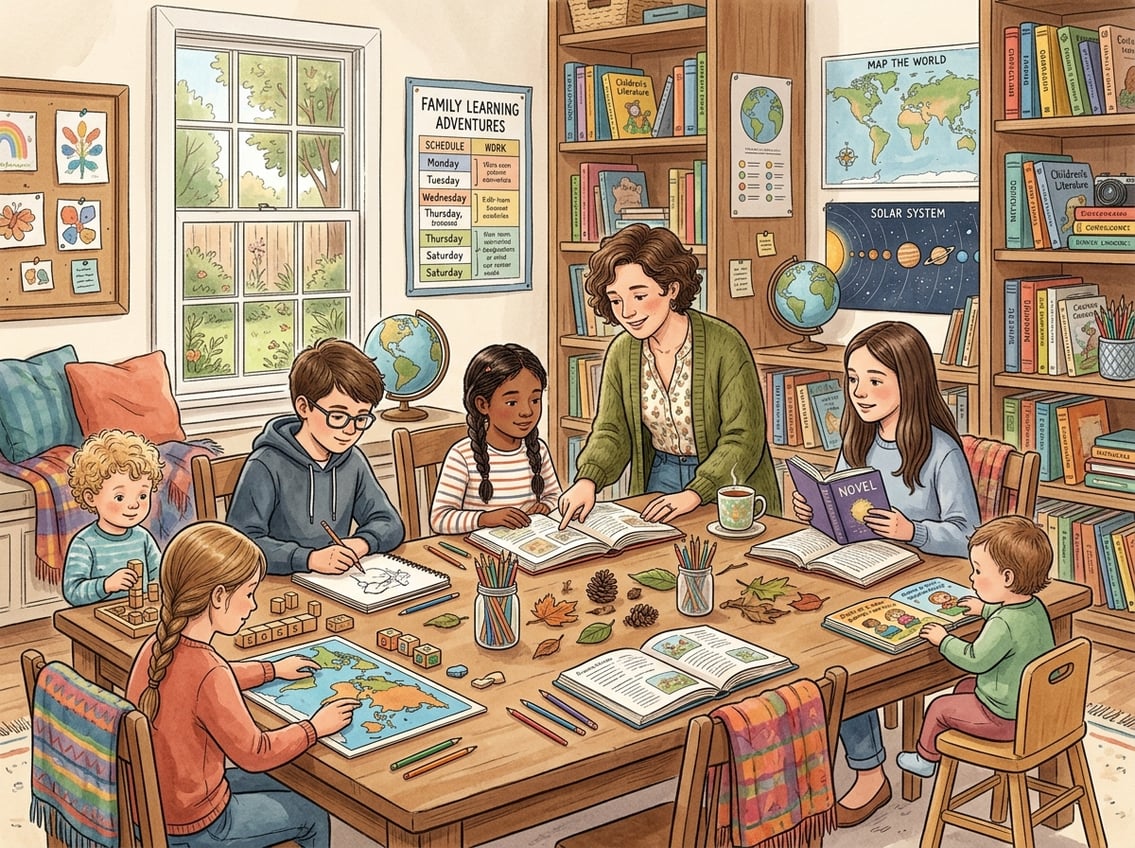
Your teaching philosophy shapes everything from the books on your shelf to the rhythm of your school day. Whether you lean toward unit studies, Charlotte Mason, or classical education, there are family-style programs built around each approach.
Some blend multiple methods beautifully.
Unit Study Programs For Learning Together
Unit studies are one of the most natural fits for multi-age families. You pick a topic, like the solar system or ancient Rome, and study it through every subject lens: reading, writing, art, science, and history all woven together.
KONOS is one of the original unit study programs. It organizes learning around character traits and includes activities designed for mixed ages.
Your kids might build a Roman aqueduct together while your older student writes about engineering principles and your younger one draws a picture of the water flowing. The strength of unit studies is immersion.
They can require more planning from you unless you choose a program with detailed daily lesson plans already built in.
Charlotte Mason-Inspired Options For Shared Reading
Charlotte Mason’s philosophy centers on living books, nature study, and short focused lessons. It practically invented the family-style approach because so much of it revolves around reading aloud together.
Ambleside Online offers a free homeschool curriculum for grades K through 12 built on Charlotte Mason’s methods. It provides structured annual schedules while allowing flexibility.
You’ll need to purchase the books separately, which can add up. A Gentle Feast, created by Julie Ross, is another Charlotte Mason-inspired option that emphasizes family bonding.
It comes with comprehensive instructional videos to help you feel confident before starting. The Charlotte Mason Institute also provides training and resources if you want to go deeper into the philosophy.
Classical Education Choices For Content-Rich Study
Classical education follows a three-stage model: grammar, logic, and rhetoric. The content-rich nature of this approach makes it surprisingly adaptable for family learning.
In a classical homeschool, your family might study the same historical period together. Your younger children memorize key facts and timelines.
Your middle schoolers analyze causes and effects. Your high schoolers debate the philosophical implications.
Programs like Generations Curriculum take a Bible-based approach that brings families together with activities suitable for various ages. The content layers naturally, so each child engages at their developmental stage without needing a completely separate program.
Christian Vs Secular Leaning Considerations
Many family-style programs come from a Christian homeschool curriculum perspective. Schoolhouse Teachers, Notgrass, Apologia, and Generations all teach from a Protestant Christian worldview.
If that aligns with your family’s beliefs, you’ll find a wide selection. If you prefer secular options, look for programs like Nautilus Homeschool or build your own using Ambleside Online’s book lists with secular substitutions.
Some families mix and match, using a Christian history curriculum they love while choosing secular science materials. Read sample lessons before buying.
Check whether the religious content is woven into the academics or presented as a separate component. That distinction matters when you’re choosing something your whole family will use daily.
Best Program Types For Shared History, Science, And More
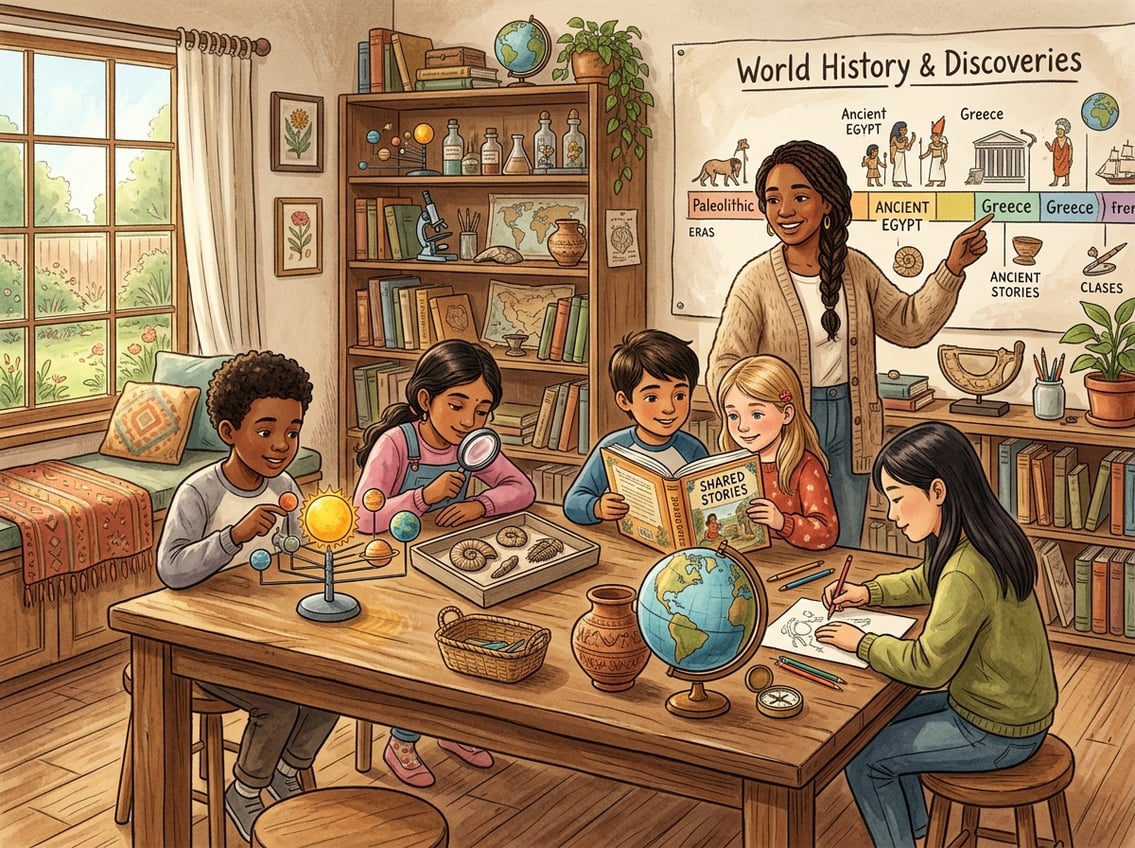
Finding the right program type matters just as much as finding the right content. Some families need everything planned out.
Others want a stack of great books and the freedom to teach their own way. Here are the main categories and which homeschool curriculum picks stand out in each.
Open-And-Go Curriculum For Busy Parents
If your prep time is limited, you need a curriculum that tells you exactly what to do each day. Open the book, follow the instructions, teach.
Notgrass is one of the strongest options here. It blends history with literature, Bible study, and writing into colorful physical workbooks with tests and quizzes included.
You can teach multiple ages from the same materials, and it covers about three to four years of study per bundle. The Good And The Beautiful also offers streamlined lesson plans that require minimal preparation.
Their language arts and history courses are designed to be visually appealing and easy to follow. This helps on those mornings when you’re running on coffee and determination.
Literature-Based Picks For Younger Mixed-Age Groups
For families with children mostly in the preschool-to-elementary range, literature-based programs are hard to beat. You read a picture book together, then explore related topics all week.
Five In A Row is the gold standard here. It offers programs starting with Before Five In A Row for ages 2 to 4 and extends through Beyond Five In A Row for ages 8 to 12.
Each week centers on one quality children’s book, with lessons in art, science, language, social studies, and math built around it. The price point is also approachable, with basic packages ranging from $50 to $170.
Your kids will remember those books for years.
Subscription Models For Flexible Family Scheduling
Subscription-based programs give you access to a broad library of courses for one flat fee. This is especially valuable for large families where per-child pricing would drain your budget fast.
Schoolhouse Teachers stands out with hundreds of courses for PreK through Grade 12 under a single annual subscription of $209 to $299. You don’t pay extra per child, and the platform covers everything from core subjects to electives.
It’s developed from a Christian perspective and includes preschool resources as well. This model works well if your family’s schedule shifts throughout the year or if you like supplementing a core curriculum with additional elective courses.
Subject-Focused Programs Worth Mixing In
Sometimes the best approach is combining specialized programs rather than relying on one company for everything. Apologia is a hands-on Christian family-style science curriculum that lets you use elementary courses with multiple children.
The experiments are engaging and designed for group participation. When your kids reach middle and high school, the program shifts to independent study.
All About Learning Press focuses specifically on reading and spelling, using a multi-sensory Orton-Gillingham approach. It only takes about twenty minutes a day and works well as a supplement alongside your family-style subjects.
Mixing subject-focused programs gives you the freedom to pick the best tool for each job.
Top Curriculum Picks By Family Situation
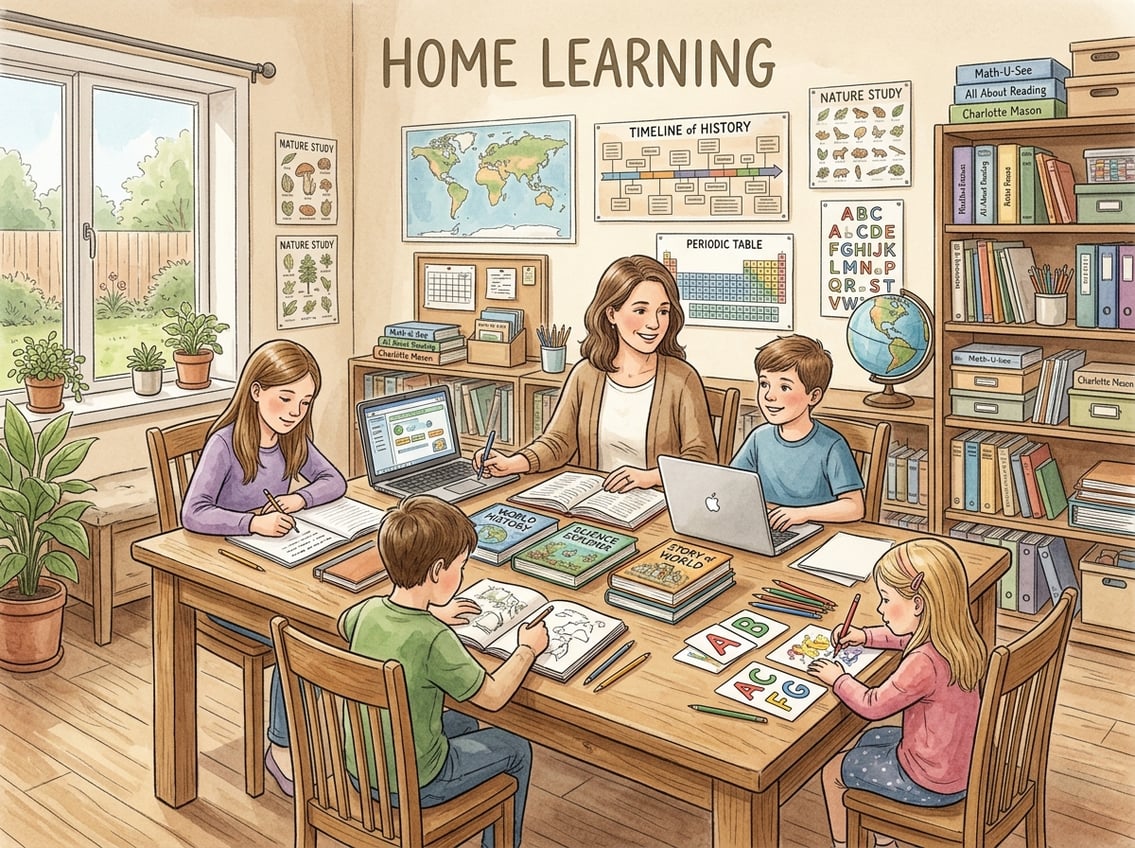
Your family size, faith background, age range, and available prep time all influence which curriculum will actually work in practice. A program that’s perfect for a family of three kids close in age might be completely wrong for a family of seven spanning preschool to high school.
Best Choices For Large Families
If you have four or more children, per-child pricing can make homeschooling expensive fast. You need programs that charge one flat fee or allow you to reuse materials.
Schoolhouse Teachers is one of the most complete options for large families, covering PreK through Grade 12 for one annual price. You never multiply your curriculum cost by the number of children.
Notgrass bundles, priced between $120 and $260, cover multiple years and work across grade ranges. Five In A Row materials can be reused with each child as they reach the appropriate age.
These are all strong homeschool curriculum for large families because they’re designed with exactly your situation in mind.
Strong Fits For Christian Households
If your faith is central to your homeschool, you want a Christian homeschool curriculum that weaves biblical teaching naturally into academics rather than treating it as an add-on. Generations Curriculum takes a Bible-based approach with collaborative family activities that encourage siblings to learn together.
Apologia builds a Christian worldview into its science courses. Schoolhouse Teachers is developed from a Protestant Christian perspective and covers every subject area.
A Gentle Feast incorporates Charlotte Mason principles within a Christian framework, with strong community support through Q&A calls and a members’ group.
Good Options For Preschool Through High School
Spanning the full age range is the biggest challenge in family-style homeschooling. You need programs that genuinely serve both your four-year-old and your fourteen-year-old.
Five In A Row covers ages 2 through 12 with its various program levels. Schoolhouse Teachers stretches from PreK through Grade 12.
Ambleside Online provides schedules for K through 12. The youngest and oldest students will need different levels of support from you.
Best Picks For Parents Who Need Low Prep
Some weeks, you barely have time to read ahead before your school day starts. You need a curriculum that does the planning for you.
Notgrass and The Good And The Beautiful both offer structured daily plans you can follow without extensive preparation. Schoolhouse Teachers provides online courses your older children can work through independently, freeing you to focus on your younger learners.
A Gentle Feast includes instructional videos that walk you through each lesson before you teach it. That extra guidance makes a real difference when you’re juggling multiple ages and feel uncertain about a subject.
Frequently Asked Questions
Which family-style curriculum options work well for teaching multiple ages together in one lesson?
Programs like Notgrass, Five In A Row, and Schoolhouse Teachers are all designed for multi-age teaching. They present one lesson to the whole family and then offer age-appropriate follow-up activities.
Science and history subjects work best for this approach because they don’t depend on sequential skill mastery.
How do I choose a program that keeps both younger kids and older kids engaged at the same time?
Look for curriculums that include hands-on activities alongside reading and discussion. Younger children stay engaged through crafts, experiments, and narration.
Older children stay challenged through writing assignments, research projects, and deeper analytical questions built into the same lesson.
What does a typical week look like when you’re using a family-style history or science curriculum?
Most families spend three to four days on group lessons lasting 30 to 60 minutes each. A typical session includes a read-aloud or video, a group discussion, and a hands-on activity.
The remaining time goes toward individual follow-up work, like notebooking for younger kids and essay writing for older ones.
How can I adapt assignments and expectations by grade level without buying extra programs?
You can adjust expectations simply by changing the output you require. Your six-year-old draws a picture and tells you three facts.
Your ten-year-old writes a paragraph. Your teenager writes a full report with citations.
The content input stays the same; only the output changes.
What supplies, books, or materials do I need to run a family-style curriculum smoothly at home?
Most programs require a teacher’s guide, the assigned books (either purchased or borrowed from the library), and basic craft or science supplies.
Programs like Ambleside Online are free to access but require purchasing many books. Subscription programs like Schoolhouse Teachers provide most materials digitally.
How do family-style curriculums handle pacing, review, and gaps when kids start at different levels?
Most family-style programs follow a cyclical approach, rotating through topics every three to four years.
For skill-based gaps in reading or math, you’ll still want individual assessments and targeted practice outside of your group lessons.
Leave a Reply