• Skip to primary navigation
  • Skip to main content
  • Skip to primary sidebar

Clever Homeschool

Fun courses based on your child's interests!

  • Home
  • Free Photo Lessons for Kids
  • “Get That Shot!” photo tags

Uncategorized

Best Homeschool Podcasts Worth Listening To in 2026

June 9, 2026 by Valerie Leave a Comment

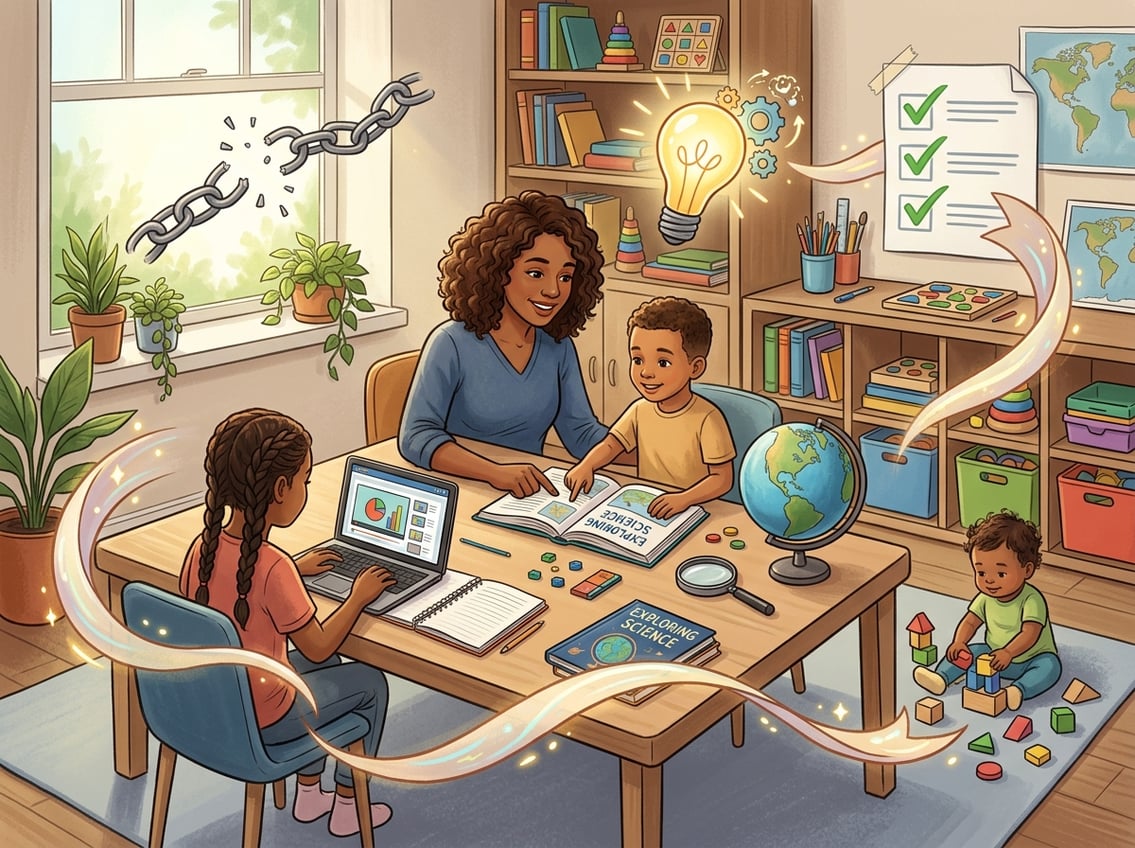
A parent and child sitting at a table in a cozy room, using a laptop and tablet surrounded by books and educational items.

Top Picks By Homeschool Need

The best homeschool podcasts in 2026 cover everything from first-year basics to high school transcript building. The right show depends on where you are in your journey.

Whether you need step-by-step curriculum guidance or just a voice reminding you that you are doing a good job, there is a podcast built for your exact situation.

Podcasts For New Homeschoolers Who Need Practical Direction

If you just pulled your kids from school or you are starting from scratch, you need clear, no-nonsense guidance. The Homeschool Solutions Show, hosted by Pam Barnhill along with rotating co-hosts, is one of the best homeschool podcasts for beginners because each episode tackles a single, specific challenge.

Joyfully Homeschooling is another strong pick. The Joyfully Homeschooling Podcast walks you through topics like setting up your first week, choosing a schedule, and managing expectations.

Episodes are short enough to finish during a school supply run. Vintage Homeschool Moms, hosted by Felice Gerwitz, blends decades of experience with live Q&A segments where you can ask your own questions.

Her perspective as someone who began homeschooling in 1986 gives new families a calm, reassuring voice. You should also check out Called to Homeschool with Meg Thomas, which speaks directly to parents who feel the pull toward home education but are not sure where to begin.

Shows For Curriculum Planning And Daily Rhythms

Choosing your homeschool curriculum is one of the most stressful parts of the year. Julie Bogart, creator of Brave Writer, hosts a podcast that reframes how you think about writing and learning rhythms.

Her approach focuses on connection over checklists. Pam Barnhill also runs a separate show focused on morning time routines that help you build poetry, art, and read-alouds into your day without overcomplicating your schedule.

Keep Calm and Homeschool On, hosted by Rebecca Spooner, covers practical planning topics like lesson batching, unit studies, and flexible scheduling. Episodes are conversational and easy to follow.

For tech-forward planning, the Homeschooling with Technology podcast hosted by Meryl van der Merwe shares short, 16-minute episodes on using apps and digital tools to streamline your teaching.

Best Options For High School And College Prep

High school homeschooling brings a new set of pressures: transcripts, credits, GPAs, and college applications. The Homeschool Highschool Podcast with Vicki Tillman is the go-to resource for this stage.

Vicki breaks down credit requirements, dual enrollment options, and how to document extracurriculars for college admissions. You will also find value in episodes of the Homeschool Solutions Show that feature guests specializing in SAT/ACT prep and scholarship applications.

These episodes give you a concrete action plan. If your teen is leaning toward trade school or entrepreneurship instead of a four-year college, look for podcast episodes that cover non-traditional post-graduation paths.

Vicki Tillman’s show addresses these routes regularly.

Podcasts For Encouragement, Balance, And Sanity

Some days you do not need another curriculum review. You need someone who gets it.

The Homeschool Sanity Show is built for exactly those moments, offering real talk about homeschool mama self-care, burnout, and finding balance in a busy household. The Smiling Homeschooler Podcast has earned a 4.9 rating on Apple Podcasts with over 137 reviews, and its entire mission is to help you smile more.

Episodes focus on homeschool encouragement rather than adding to your to-do list. Homeschool with Moxie, hosted by Abby Banks, blends actionable strategies with interviews from experienced homeschool influencers.

The goal is to move you from overwhelmed to confident. For a lighter listening experience, podcasts for homeschoolers like make joy normal: cozy homeschooling offer bite-sized episodes (around 8 minutes) that fit into the busiest days.

Shows That Match Your Homeschool Philosophy

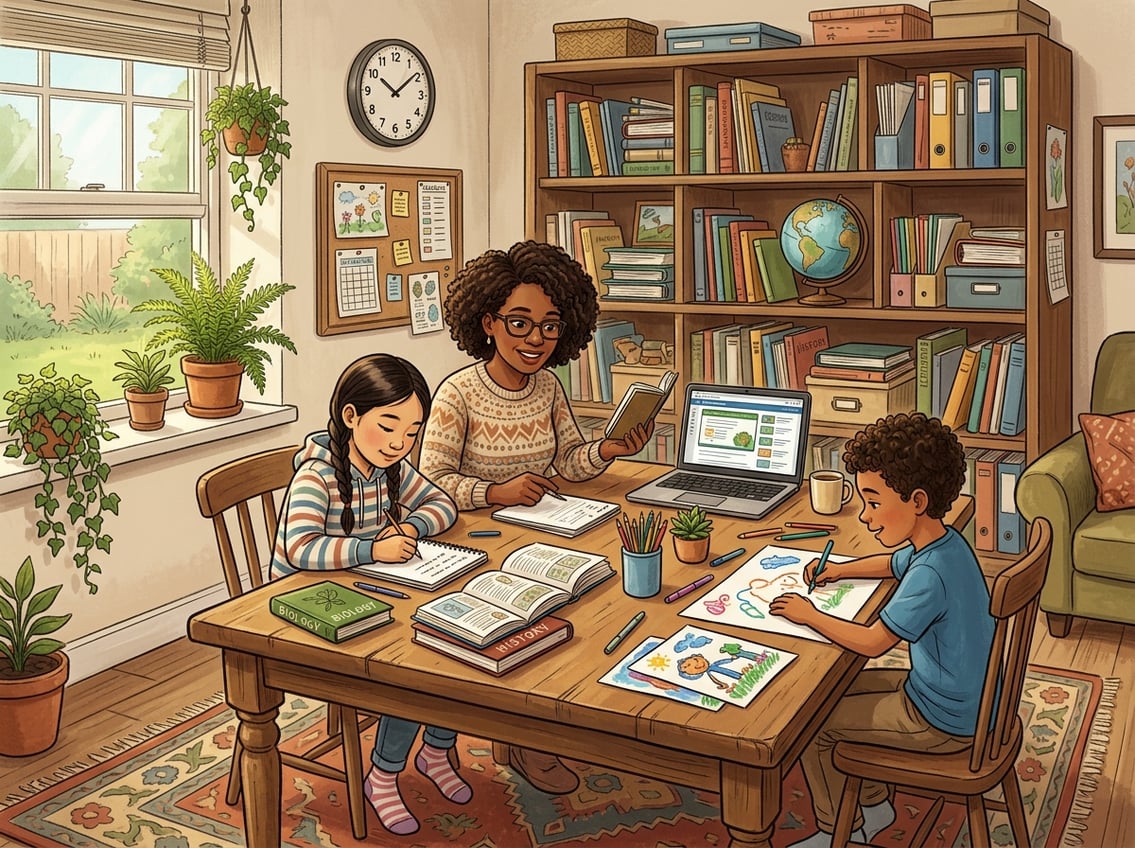
A family gathered around a table with books and a tablet, engaged in a homeschool learning activity in a cozy living room.

Your homeschool philosophy shapes everything from the books on your shelf to the way your Tuesday afternoon looks. These homeschooling podcasts align with specific educational approaches so you can learn from hosts who teach the way you want to teach.

Charlotte Mason And Literature-Rich Listening

If you love living books, nature study, and short lessons, Charlotte Mason education has a strong podcasting community behind it. Homeschooling Outside the Box, hosted by Cindy Rinna, focuses on Charlotte Mason methods while also addressing the unique needs of children who do not fit a standard mold.

Sarah Mackenzie, known for her work on reading aloud and building a literature-rich home, offers episodes that help you weave great books into every subject. Her practical reading lists and discussion guides make it simple to start.

The Homeschool Sisters Podcast, with over 1.6 million downloads worldwide, regularly features Charlotte Mason topics alongside other gentle approaches. Hosts Cait Curley and Kara Anderson keep conversations warm and grounded.

Julie Bogart’s Brave Writer podcast also fits here. Her emphasis on literary experiences and writing as a natural part of life pairs well with a Charlotte Mason framework.

Interest-Led, Unschooling, And Self-Directed Approaches

If your family follows the child’s curiosity rather than a preset scope and sequence, you need hosts who speak your language. Exploring Unschooling with Pam Laricchia is the standout podcast in this space.

Pam interviews families practicing unschooling and self-directed learning, giving you real-life examples of how interest-led learning plays out over years. Homeschool Unrefined takes a relaxed, honest approach that resonates with families who blend unschooling with other methods.

The hosts discuss everything from screen time to deschooling without judgment. Raising Lifelong Learners is another excellent option if your kids dive deep into passions like robotics, history, or art.

The show supports families who want to nurture curiosity without forcing a rigid structure.

Support For Neurodivergent And Twice-Exceptional Learners

Homeschooling a twice-exceptional child, one who is gifted and also has learning differences, requires a different kind of support. The Homeschool Sisters Podcast frequently covers neurodivergent topics and features guests who specialize in ADHD, autism, dyslexia, and sensory processing.

Empowering Homeschool Conversations brings together five hosts with over 75 years of combined experience in special education homeschooling. Topics include IEP alternatives, adaptive curriculum, and advocacy strategies.

Raising Lifelong Learners also dedicates episodes to twice-exceptional learners, offering specific strategies for balancing a child’s strengths with their areas of struggle. If your child thinks differently, these shows remind you that your homeschool can be designed to fit them perfectly.

How To Choose Podcasts You Will Actually Keep Listening To

A parent and child in a home study area, with the parent listening to a podcast on a device while the child reads and works nearby.

With dozens of homeschooling podcasts available, the real challenge is not finding a show. It is finding shows you will stick with week after week.

The right fit depends on your personality, your schedule, and what you actually need right now.

Pick By Host Style, Episode Length, And Season Of Life

Not every host will click with you, and that is fine. Some homeschooling moms prefer a structured, teaching-style format.

Others want to feel like they are chatting with a friend over coffee. Before subscribing, listen to one full episode and ask yourself: does this person’s voice and energy match what I need on a hard Wednesday?

Episode length matters more than you might think. If you only have 15 minutes during school pickup, a 58-minute deep-dive will pile up in your queue.

Shows like make joy normal keep episodes around 8 minutes, while The Homeschool Sisters Podcast runs closer to 44 minutes. Match the length to your available listening windows.

Your season of life also matters. A podcast about toddler management will not serve you if your youngest is 14.

Pick shows that speak to where you are this year, not where you were three years ago.

Build A Small Rotation Instead Of Following Everything

You do not need to subscribe to 20 shows. A rotation of three to five podcasts gives you enough variety without creating another source of overwhelm.

Try this simple framework:

  • One show for practical planning (curriculum, scheduling, daily rhythms)
  • One show for encouragement and mindset
  • One show that matches your teaching philosophy

Swap a show out when it stops feeling useful. Your needs will shift as your kids grow, and your podcast lineup should shift with them.

Homeschooling with technology tools like playlist features on Apple Podcasts or Spotify makes it easy to organize your rotation by topic.

Use Podcast Listening To Strengthen Your Homeschooling Community

Podcasts can feel like a solo activity, but they do not have to be. Share an episode with a friend from your homeschooling community and discuss it over lunch.

Bring up a topic from a recent show at your co-op meeting. Some shows, like Vintage Homeschool Moms, even host live events where you can ask questions in real time.

Many podcast hosts also run private Facebook groups or online forums tied to their shows. Joining one of these spaces turns passive listening into active connection with other families who share your approach.

If you are feeling isolated, a single podcast episode paired with a text to another homeschooling parent can turn a lonely Tuesday into a moment of genuine support.

Frequently Asked Questions

A home study setup with a laptop, headphones, books, and a globe on a desk near a window.

Which homeschool podcasts are best for new homeschooling parents?

The Homeschool Solutions Show with Pam Barnhill is an excellent starting point because it covers one focused topic per episode in a beginner-friendly way. Joyfully Homeschooling and Called to Homeschool with Meg Thomas also walk you through the early decisions like choosing a method, setting realistic goals, and building your first daily routine.

Where can I listen to homeschool podcasts for free (Spotify, YouTube, or other apps)?

Most homeschool podcasts are completely free on Apple Podcasts, Spotify, and YouTube. Shows like Coffee With Carrie, Homeschool with Moxie, and The Smiling Homeschooler Podcast are all available across multiple platforms.

You can also use free apps like Goodpods or Google Podcasts to discover and organize your favorites.

What are the best Christian homeschool podcasts for faith-based families?

Let’s Talk Homeschool with Davis and Rachael Carman is produced by Apologia and centers every episode on biblical principles. Vintage Homeschool Moms with Felice Gerwitz, a Christian homeschool veteran since 1986, is another strong choice.

Coffee With Carrie also weaves faith into practical homeschool advice with a warm, supportive tone.

Which podcasts offer practical homeschool planning, curriculum, and scheduling tips?

Homeschooling Podcast

Keep Calm and Homeschool On with Rebecca Spooner covers lesson planning, unit studies, and flexible scheduling in detail. The Homeschooling with Technology podcast shares quick 16-minute episodes on using digital tools for organization.

Julie Bogart’s Brave Writer podcast is also helpful if you want to rethink how writing and language arts fit into your weekly rhythm.

What are the best educational podcasts for kids that work well with homeschooling?

Shows recommended by Kids Listen are a great place to start for literacy, creativity, and STEM content. Look for podcasts that cover science stories, history adventures, or read-aloud fiction, as these pair naturally with your lesson plans.

Many homeschool families use kid-focused podcasts during lunch, car rides, or as a supplement to a specific unit study.

Are there kid-friendly homeschool podcasts that siblings of different ages can enjoy together?

Kid-friendly podcasts illustration

Story-based and science exploration podcasts tend to work across a wide age range because they engage listeners through narrative rather than grade-level content.

Shows that feature short episodes (under 20 minutes) are especially good for mixed-age listening.

Younger kids stay engaged while older kids still find the content interesting.

Check the episode descriptions to confirm topics are appropriate for your youngest listener.

Filed Under: Uncategorized

Top Homeschool Conferences Worth Attending in 2026

June 9, 2026 by Valerie Leave a Comment

A family of four sitting around a table looking at brochures and calendars, planning an educational event together in a cozy living room.

How To Choose The Right Event For Your Family

Finding the right homeschool conference depends on your teaching style, your budget, and your current needs. The best event for your family is the one that matches where you are in your homeschool journey, not necessarily the one with the biggest name.

Whether you need hands-on time with homeschool curriculum, want to connect with a thriving homeschool community, or are figuring out how to homeschool for the first time, the right event is out there.

What First-Time Attendees Should Prioritize

If this is your first homeschooling conference, keep your goals simple. Focus on attending a few beginner-friendly workshops and spending time in the exhibit hall.

Look for homeschool events that specifically welcome new families. Many regional conventions offer “getting started” tracks for parents still exploring how to homeschool.

These sessions cover legal requirements, curriculum options, and daily scheduling basics.

Avoid buying a stack of curriculum on day one. Walk the floor first, ask vendors questions, and take home catalogs.

As noted by Homeschool Start Guide, the vendor hall is most useful when you arrive with specific questions. Your first conference is about gathering information, not making big purchases.

Choosing Between Large Regional Events And Smaller State Gatherings

Large regional conventions like Great Homeschool Conventions draw thousands of homeschool families from multiple states. You get access to dozens of nationally known speakers, hundreds of vendor booths, and a wide variety of workshops.

The trade-off is that these events can feel overwhelming, and ticket prices tend to run higher. Smaller state gatherings offer a more relaxed pace and locally focused content.

You will often find tighter-knit community connections and lower costs at state-level homeschool conferences. These events also tend to address your specific state’s homeschooling laws and resources.

If you want maximum vendor selection and big-name speakers, a large event makes sense. If you want to meet nearby homeschool families and build lasting local connections, a smaller state convention is the better fit.

When A Curriculum-Focused Event Makes More Sense Than A Full Conference

Not every family needs a multi-day conference with keynote speakers and networking dinners. Sometimes you just need to compare math programs side by side.

Curriculum fairs and homeschool expos are shorter, more focused events where vendors display their products and you can flip through materials in person. These are ideal if you already know your teaching approach and simply need to find the right resources.

A full homeschooling conference or homeschool summit is a better choice when you want workshops, encouragement from speakers, and time to recharge your motivation. If you feel confident in your curriculum but burned out on homeschooling itself, a conference with strong speaker sessions is a better fit.

Best Fits For Christian, Catholic, Secular, And Charlotte Mason Families

Your worldview and educational philosophy should guide your event selection.

  • Christian homeschool conference: Events like Great Homeschool Conventions and Teach Them Diligently center their content around Christian faith and family values. Most large regional conventions lean Christian.
  • Catholic homeschool conference: Catholic families will find dedicated events such as the IHM Conference or regional Catholic homeschool gatherings that align curriculum and speakers with Catholic teaching.
  • Secular families: Look for an unschooling conference or secular home education expo where content is not tied to any religious framework. These events tend to be smaller but are growing in number.
  • Charlotte Mason families: Charlotte Mason-focused gatherings, including retreats and small conferences, center on nature study, living books, and narration. These attract families who want philosophy-specific community.

Matching your family’s values to the right event ensures you walk away with practical ideas you will actually use.

Standout Conferences To Put On Your 2026 List

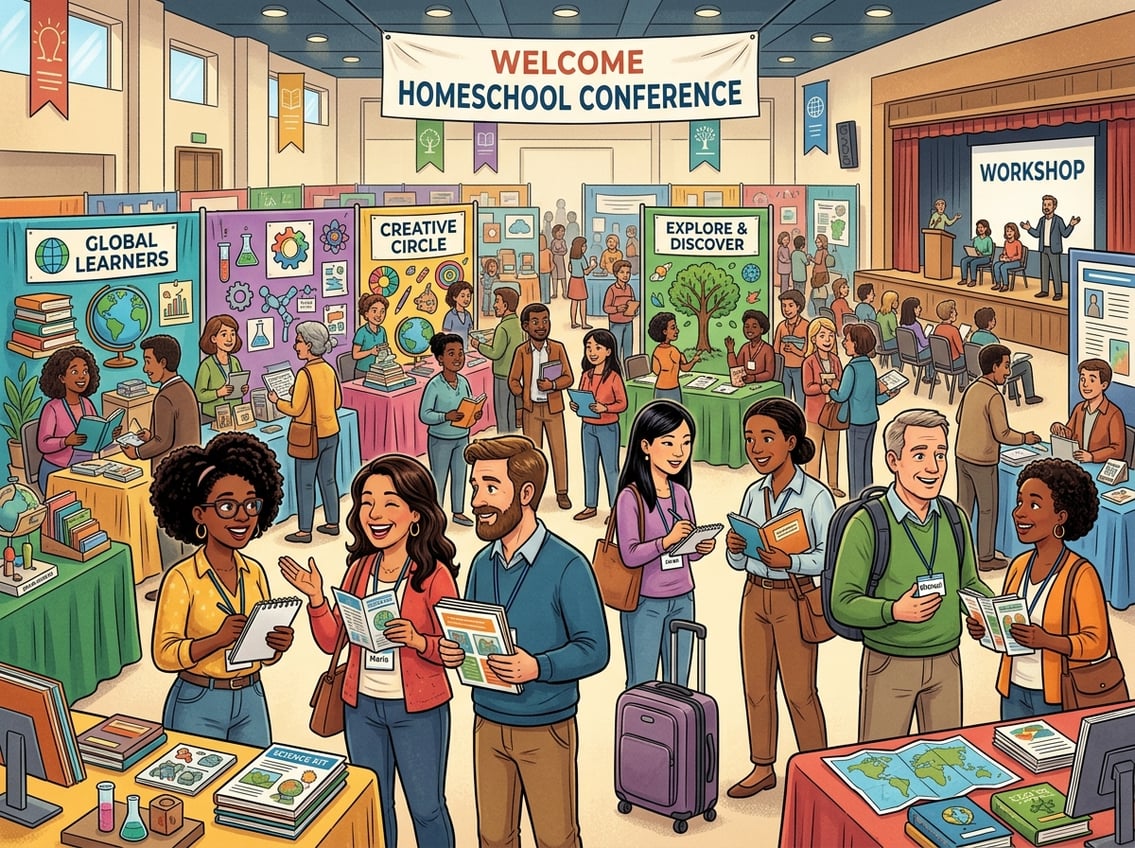
A group of parents and children interacting at a homeschool conference with booths and informational tables in a spacious conference hall.

Several homeschool conferences stand out in 2026 for their speaker lineups, vendor halls, and community atmosphere. From large multi-state tours to smaller state-run events and niche gatherings, here are the ones worth marking on your calendar.

Great Homeschool Conventions And Other Large Multi-State Events

Great Homeschool Conventions remain the largest circuit of homeschool events in the country. GHC hosts multiple conventions across different states each year, including stops in cities like St. Charles, Missouri and locations in Illinois.

Each event features dozens of workshops, nationally recognized speakers, and a massive exhibit hall packed with curriculum vendors. If you want the widest possible selection of resources under one roof, GHC is hard to beat.

Teach Them Diligently is another major multi-state option. Their events combine family-friendly programming with worship, workshops, and a sizable vendor floor.

Both GHC and Teach Them Diligently lean Christian in content and culture. For families who want a broader mix, the Homeschool Yo Kids Expo and similar community-focused expos offer inclusive programming that welcomes diverse homeschool families.

Best State And Regional Picks Across The U.S.

State-level conventions deliver strong value, often at lower ticket prices than the national tours.

  • FPEA Homeschool Convention (Florida): One of the largest state conventions in the Southeast, known for its extensive vendor hall and wide range of workshop topics.
  • THSC Convention (Texas): The Texas Homeschool Convention draws thousands of families each year and covers everything from curriculum to college prep.
  • AFHE Home Education Convention (Arkansas): A well-organized event with a loyal following and solid speaker lineup.
  • CHEA Conference (California): The California Homeschool Convention serves West Coast families with sessions on legal issues, teaching methods, and curriculum exploration.
  • Homeschool Iowa Conference: A strong Midwest option with affordable pricing and a welcoming atmosphere.
  • Rocky Mountain Homeschool Conference: Serves families across Colorado and neighboring states with practical workshops and a quality exhibit hall.

According to That Homeschool Family’s comprehensive list, you can find homeschool conventions organized by state. This makes it easy to locate an event near you or plan a road trip to one worth the drive.

Notable Specialty And Community-Focused Gatherings

Beyond the big conventions, specialty events serve families with specific needs. The Family Homeschool Conference format brings parents and kids together for shared learning experiences rather than separating them into different tracks.

Black homeschooling families can find events tailored to their community, including expos and summits that center culturally responsive curriculum and representation. These gatherings have grown significantly in recent years.

Catholic, Charlotte Mason, and unschooling communities each host their own retreats and small conferences. These events let you connect deeply with families who share your approach.

If the large convention scene feels too broad, a specialty gathering might be exactly what you need.

Getting The Most Value From Your Trip

A group of homeschool parents and educators interacting at a busy conference with booths and educational materials.

A little planning turns a good homeschool convention experience into a great one. Knowing what to buy, when to volunteer, and how to pace yourself can save you hundreds of dollars and prevent exhaustion.

What To Do In The Exhibit Hall Before You Buy

Walk the entire exhibit hall at least once before you spend a dollar. Bring a notebook or use your phone to jot down booth numbers, prices, and first impressions.

Ask vendors specific questions about your child’s learning style and grade level. Most curriculum companies send knowledgeable representatives who can give you tailored advice.

Pick up catalogs and free samples so you can review them later. Many vendors at homeschool conventions offer convention-exclusive discounts on both new and discontinued curriculum, so compare prices before committing.

If you see a deal that seems great, ask if it will still be available on the last day. Often it will be.

Budgeting For Tickets, Travel, And Hotel Deals

Ticket prices for homeschool conventions range from free local curriculum fairs to $100+ for multi-day national events. Set a total trip budget that includes tickets, gas or airfare, hotel nights, meals, and curriculum purchases.

Book your hotel early. Many conventions negotiate group rates at nearby hotels, and those blocks fill up fast.

Carpooling with another homeschool family cuts travel costs and makes the drive more fun. Watch for early-bird ticket pricing.

Buying your tickets months in advance can save you $20 to $50 per person, which adds up quickly for a family.

Using Volunteer Opportunities To Cut Costs

One of the easiest ways to attend a homeschool convention for free is to volunteer. Many events offer complimentary or discounted admission in exchange for a few hours of help before, during, or after the event.

Tasks might include setting up vendor tables, directing attendees to sessions, or helping with registration. Check the convention website early in the year, because volunteer spots fill up quickly.

Even a half-day volunteer shift can eliminate your ticket cost entirely.

How To Plan Your Schedule Without Burning Out

Multi-day events pack in dozens of workshops, and the temptation is to attend as many as possible. Resist that urge.

Pick your top three to four sessions per day and leave gaps between them. Use that free time to revisit the exhibit hall, grab a snack, or simply sit and process what you have learned.

If you are attending with a spouse or friend, split up for certain sessions and share notes afterward. This doubles the content you cover without doubling the fatigue.

Comfortable shoes, a refillable water bottle, and a lightweight backpack will make a bigger difference than you expect.

Frequently Asked Questions

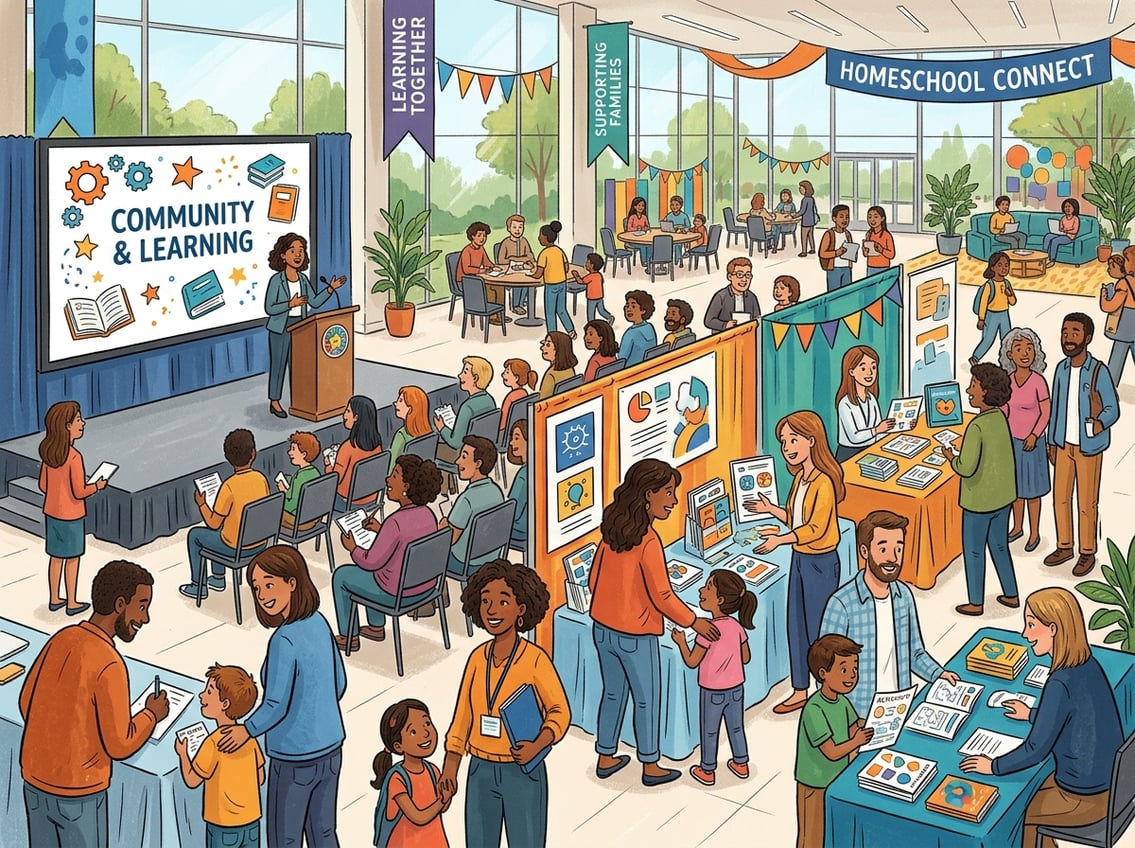
A group of people attending a homeschool conference, engaging in workshops and networking in a bright, spacious hall.

Which homeschool conferences are the best to attend in 2026?

The best homeschool conferences for 2026 include Great Homeschool Conventions, Teach Them Diligently, the FPEA Homeschool Convention in Florida, and the THSC Convention in Texas. Your best pick depends on your location, budget, and whether you prefer a large national event or a focused state-level gathering.

How do I find a homeschool convention near me in 2026?

The easiest way is to check a comprehensive list of homeschool conventions organized by state. You can also search your state homeschool association’s website, as most of them list their annual conference dates and locations well in advance.

What should I expect at a large homeschool convention like GHC?

At a Great Homeschool Convention, you can expect a multi-day event with dozens of workshops, keynote speakers, and a large exhibit hall filled with curriculum vendors. Plan to wear comfortable shoes, bring a backpack for catalogs and purchases, and build breaks into your schedule to avoid burnout.

Are there homeschool conferences specifically for Christian families?

Yes. Great Homeschool Conventions, Teach Them Diligently, and many state-level events like AFHE and THSC center their content around Christian faith. Master Books and similar publishers also host or participate in events specifically designed for Christian homeschool families.

Are there homeschool conferences designed for Black homeschooling families?

Yes. Several expos and summits focus specifically on Black homeschooling families, including the Homeschool Yo Kids Expo and other community-driven gatherings. These events feature culturally responsive curriculum, representation-focused speakers, and networking opportunities for families of color.

Which state-based homeschool conventions are worth traveling for (e.g., CHAP or FPEA)?

Homeschool Convention

FPEA in Florida, THSC in Texas, CHEA in California, and CHAP in Pennsylvania are among the most popular state conventions that draw families from neighboring states.

Each one offers a strong exhibit hall and quality speakers. These conventions also provide enough programming to justify the travel costs, especially if you combine the trip with a family outing.

Filed Under: Uncategorized

How To Organize Your Physical Curriculum: Smart Storage

June 9, 2026 by Valerie Leave a Comment

Sort What Stays, Moves, Or Goes

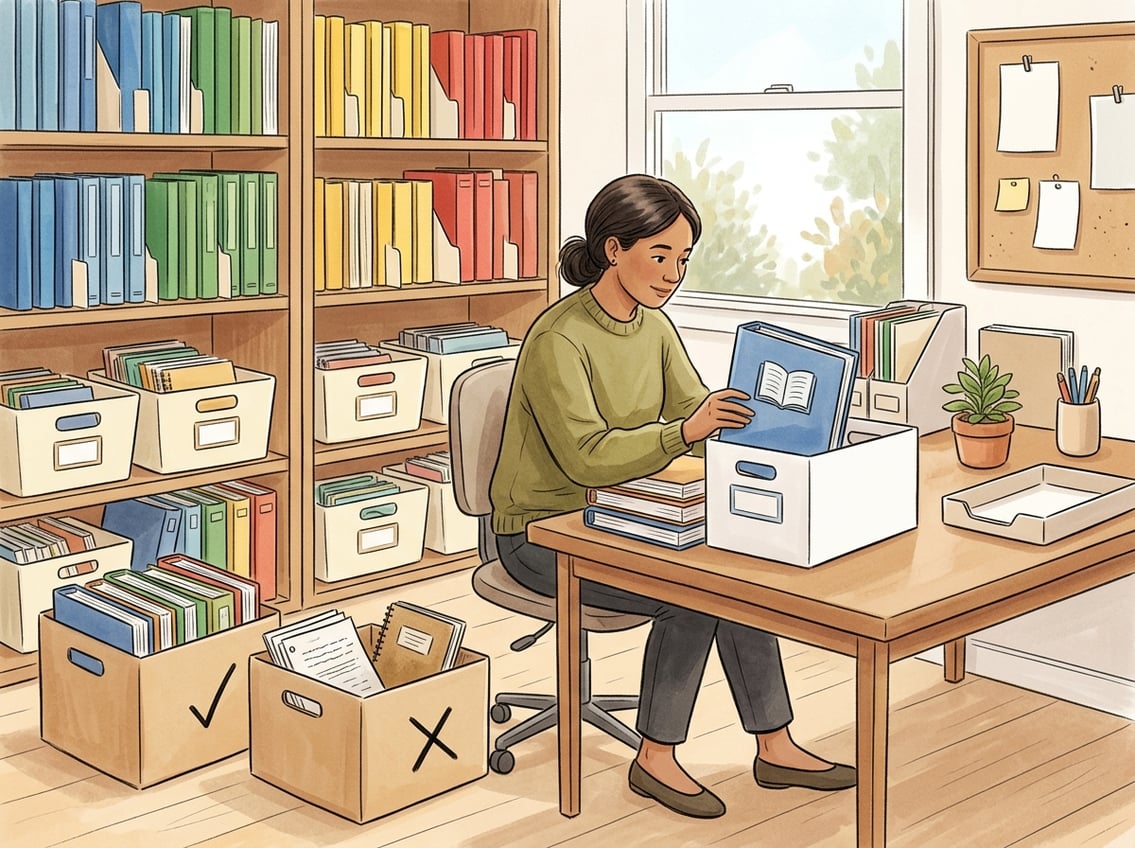
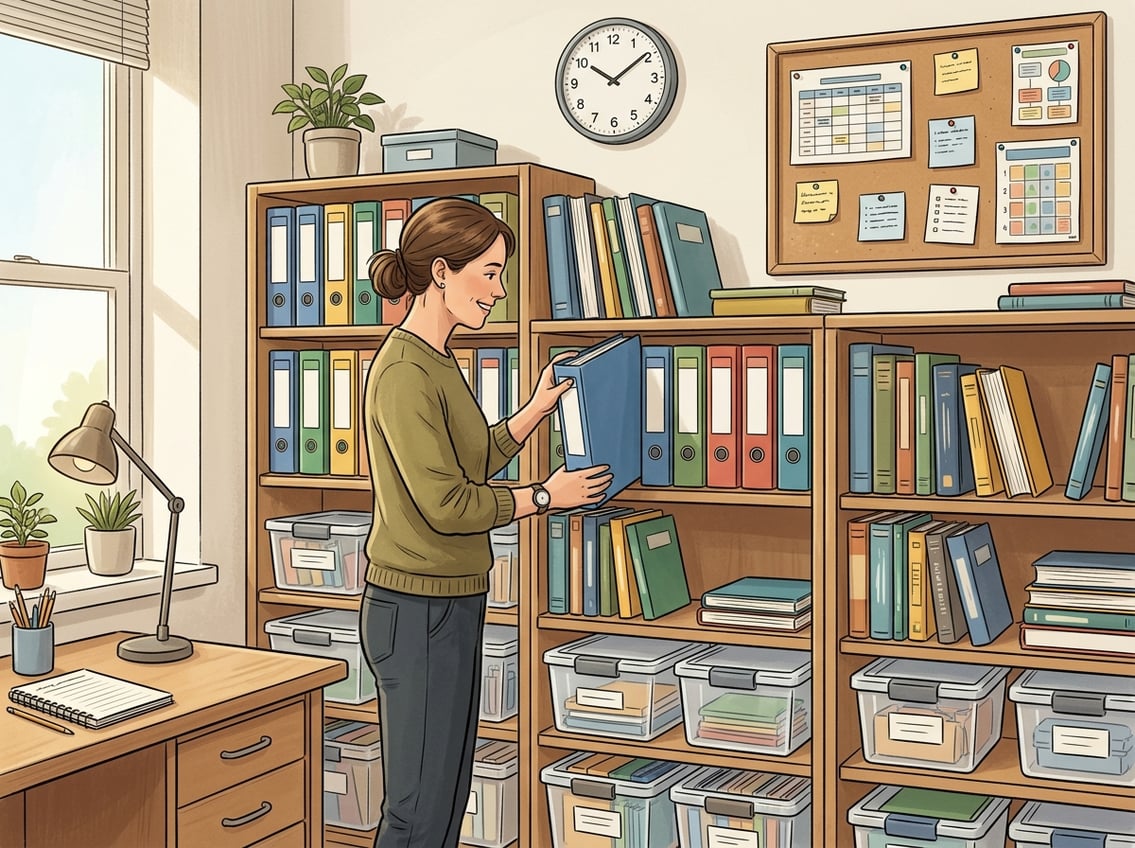
A person organizing binders, bookshelves, and storage boxes in a tidy workspace dedicated to managing physical curriculum materials.

Before you buy a single bin or binder, you need to make honest decisions about what deserves prime real estate in your teaching space.

The fastest way to fail at organizing teaching materials is to try organizing everything at once without sorting first. A clear sort saves you hours of reshuffling later.

Separate Daily-Use Materials From Archive Items

Pull every piece of curriculum you own into one spot.

Now split it into three piles: daily-use, occasional reference, and archive.

Daily-use items are the teaching resources you reach for every single day. Think current teacher manuals, active student workbooks, and this week’s handouts.

These belong within arm’s reach of your main workspace.

Occasional reference materials include things like assessment banks, supplemental readers, and enrichment packets you pull out once or twice a month.

Store these nearby but not front and center.

Archive items are completed units, past-year curricula, and anything you won’t touch for months.

Box these up and move them to a closet, garage shelf, or under-stairway cabinet where they stay accessible without cluttering your organized classroom.

Group Resources By Subject, Unit, And Grade Level

Once you know what stays in your active workspace, group it logically.

The most practical approach is to sort by subject first, then by unit or chapter within each subject.

If you teach multiple grade levels, add a grade-level layer.

You can designate a shelf for each grade level starting with the highest on top and working down.

Color coding by subject or grade makes grabbing the right stack almost automatic.

Use Your Curriculum Map To Decide Priority Access

Your curriculum map is the secret weapon here.

Pull it out and look at what you’re teaching this month and next month.

Those units get front-row placement in your workspace.

Everything scheduled for later in the year can sit further back on shelves or in labeled bins.

When you align your physical storage to your curriculum map, your digital resources and paper materials stay in sync.

You’ll spend less time hunting and more time teaching.

Build A Binder System That Speeds Up Planning

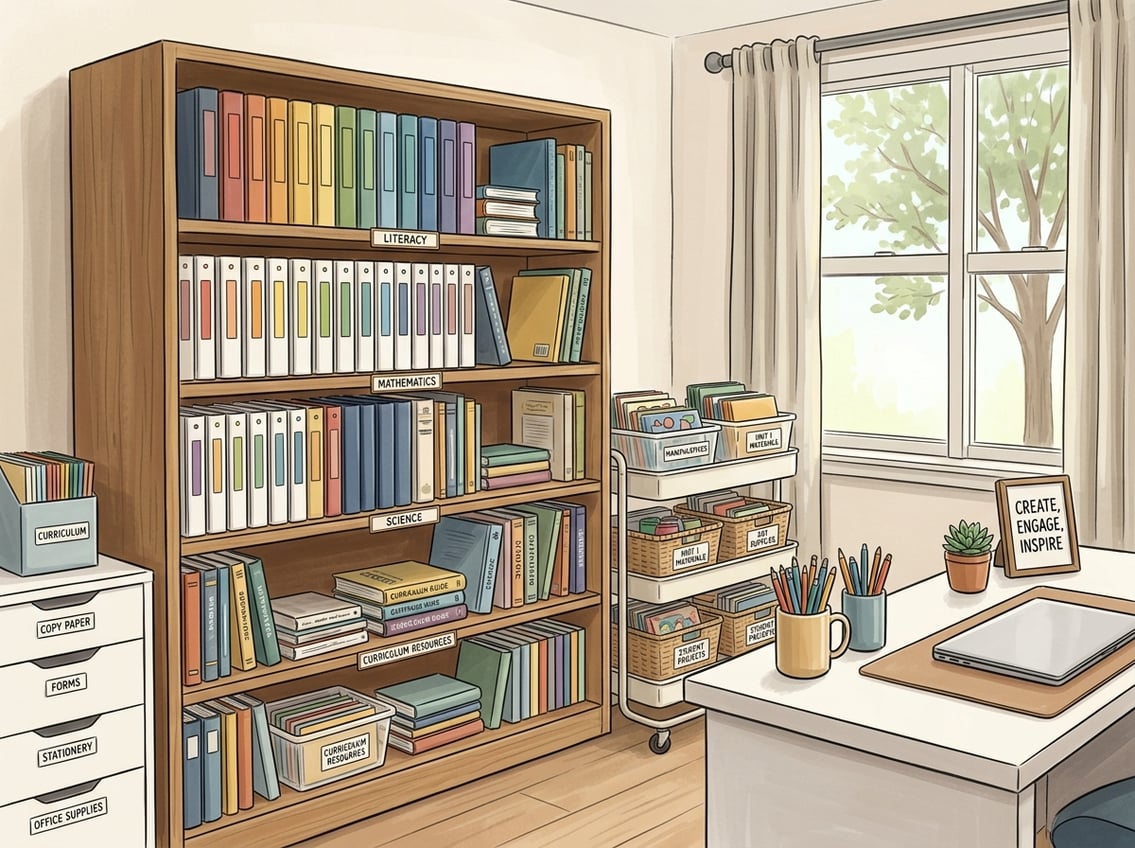
An organized workspace with binders, bookshelves, and stationery arranged neatly for curriculum planning.

A solid binder system turns a messy stack of loose pages into a planning tool you can actually use on a Monday morning.

The right setup keeps lesson plans, reference sheets, standards documents, and student work flowing smoothly through your week.

Set Up A Teacher Binder For Core Reference Pages

Your teacher binder is your command center.

Start with a sturdy 2-inch three-ring binder and fill it only with the pages you reference repeatedly: pacing guides, standards checklists, contact lists, and your weekly planning templates.

A well-built curriculum binder holds everything from lesson plans to standards so you never have to dig through drawers mid-lesson.

Keep it lean.

If a page doesn’t get looked at weekly, it belongs somewhere else.

Use Tab Dividers, Page Protectors, And Binder Covers

Tab dividers are what make a binder actually functional instead of just a prettier pile of papers.

Use one tab per subject or per major category (plans, data, admin, communication).

Slip your most-handled pages into page protectors.

Grade-level checklists, emergency sub notes, and frequently photocopied originals last dramatically longer this way.

Durable binder covers in distinct colors help you tell binders apart at a glance from across the room.

Label Spines Clearly For Fast Grab-And-Go Access

Spine labels sound like a small detail, but they save real time.

Print clear, bold labels that include the subject, grade, and time period.

For example: “Math | Grade 3 | Units 1-4.”

When every binder in your collection has a readable spine label and coordinating color, you can pull the right one off a shelf in seconds.

No flipping open covers to check what’s inside.

Create Student Binder Routines For Ongoing Classwork

Student binders work best when your students know exactly what goes in, where it goes, and when to file it.

Keep the setup simple: one tab per subject or unit, with a “to do” section in front and a “completed” section in back.

Teaching children to implement and maintain an effective binder system strengthens organizational skills they’ll use far beyond your classroom.

Build in a two-minute “file and check” routine at the end of each class period.

Student binders stay useful only when the routine is consistent.

Choose Shelves, Bins, And Carts By Material Type

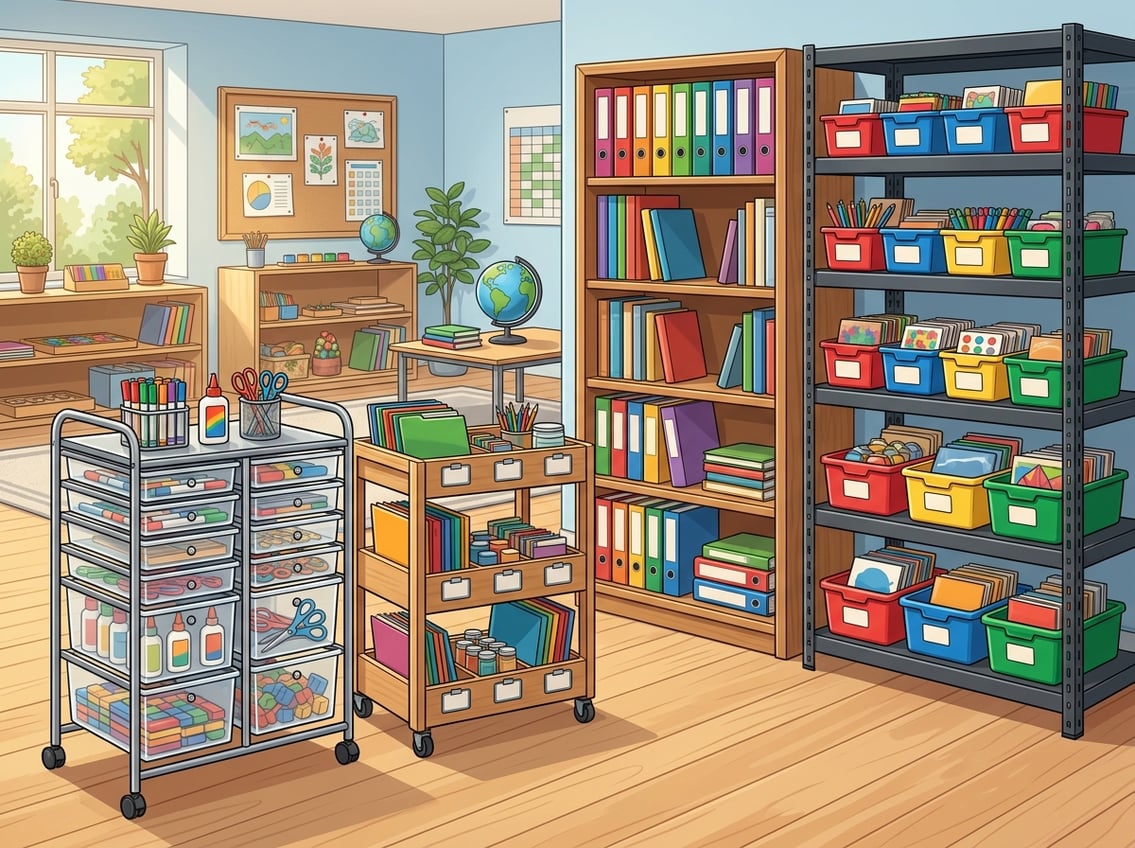
An organized storage area with wooden bookshelves, colorful plastic bins, and mobile carts holding binders, books, and classroom supplies.

Different materials need different homes.

Heavy teacher manuals don’t belong in the same flimsy bin as flashcard sets, and student workbooks you rotate weekly need faster access than reference books you open once a semester.

Matching your classroom storage solutions to the size, weight, and frequency of use for each item keeps everything accessible and protected.

Store Teacher Manuals And Workbooks On Bookshelves

Bookshelves are still the most reliable option for heavy, frequently used books.

Place your current teacher manuals and student workbook sets on shelves at eye level or just below, where you can read spines without bending.

Adjustable metal library-style shelving can support hundreds of pounds of evenly distributed weight, making it ideal for thick curriculum sets and encyclopedias.

Reserve the top shelf for items you access less often, like next semester’s materials.

Keep active units at the front edge of the shelf so nothing gets buried.

Use Book Bins And Drawer Organizers For Small Sets

Not everything fits neatly on a bookshelf.

Manipulatives, flashcard decks, small supplemental readers, and individual worksheet packets do better in book bins or drawer organizers.

Clear plastic bins let you see contents instantly.

If you prefer fabric bins, label them or use a different color for each subject so students and adults can locate items without opening every container.

Stackable drawer organizers work especially well for sorted worksheet sets and loose supplies that would otherwise float around your classroom.

Add Rolling Carts For Materials That Travel Around The Room

If you teach at multiple tables, run small group stations, or share a space with other teachers, rolling carts are a game changer.

Load one cart per subject or per group rotation with everything that station needs.

Rolling carts provide a smart storage solution for flexible spaces because you can wheel them into position during class and tuck them away afterward.

A three-tier cart holds a surprising amount: binders on the top tier, workbooks in the middle, and supplies on the bottom.

Maximize Vertical Space With Wall-Mounted Shelves

Floor space is almost always limited.

Wall-mounted shelves let you store materials up high without taking away any square footage.

As noted by early childhood education specialists, wall-mounted shelving protrudes less into the room than freestanding units.

Use them for reference books, archive binders, or display copies you want visible but not constantly handled.

Pair them with small labeled bins for lightweight items like flashcards, timers, or math manipulatives.

Set Up Retrieval And Return Routines That Last

An organized workspace with binders, bookshelves, storage boxes, and a tidy desk with stationery and a laptop.

Even the most beautiful classroom organization falls apart without routines that tell everyone where things go and how they get back there.

The systems below are simple enough for students to follow independently and sturdy enough to survive an entire school year.

Create Simple Labels Students And Adults Can Follow

Labels are the backbone of any organized classroom.

Every shelf, bin, drawer, and binder slot needs a clear label that includes both words and a visual cue like a color dot or icon.

Use a large, readable font.

Laminate labels or cover them with packing tape so they survive daily handling.

When a substitute teacher or parent volunteer walks in, they should be able to return any item to its correct spot without asking a single question.

Assign Homes For In-Progress Work And Reused Materials

In-progress student work is where most classroom storage solutions break down.

Designate a specific bin, folder, or shelf section exclusively for work that’s started but not finished.

A cascading vertical filing system hung on a wall works especially well for this if you teach multiple students or class periods.

Assign each student or period a color-coded slot.

Reusable materials like laminated task cards or game boards need their own clearly marked “return here” bin so they don’t drift into the completed-work pile.

Protect High-Use Originals And Master Copies

Your master copies of worksheets, tests, and activity pages are irreplaceable time-savers.

Never store them loose in a drawer.

Place each master in a page protector inside a dedicated binder, organized by unit.

Store this binder away from the student-access area so originals don’t get accidentally written on, crumpled, or spilled on.

If a master sheet starts showing wear, make a fresh copy from it immediately and retire the original to a protective sleeve.

This small habit saves you from having to recreate materials from scratch mid-year.

Maintain The System Without Reorganizing All Year

A person organizing binders and books on shelves in a tidy study room with storage boxes and educational materials.

A good system should run on maintenance, not makeovers.

With a few small habits built into your week, your organizing teaching materials setup can stay clean from August through June without a single weekend overhaul.

Schedule Quick Weekly Resets

Pick one day each week for a ten-minute reset.

Friday afternoons work well because you close out the week with a clean slate.

During the reset, check that every binder is on its correct shelf, every bin is labeled and in position, and nothing has piled up in the wrong spot.

Have students participate for the last two minutes of class by returning their own materials and checking their binder sections.

Consistency matters more than perfection here.

A quick weekly sweep prevents the slow creep of disorder.

Archive Finished Units Without Losing Access

When you wrap up a unit, don’t just shove the materials to the back of a shelf.

Remove the unit’s resources from your active classroom storage, place them in a labeled bin or binder sleeve, and move them to your archive spot.

Write the unit name, grade level, and date on the outside.

If you keep your archive organized in the same subject-then-unit order you used during the year, you can pull any past unit back out in under a minute.

This keeps your daily workspace lean without making old materials hard to find.

Back Up Paper Systems With Lightweight Digital Records

You don’t need to go fully digital to benefit from digital resources. Snap a quick photo of your binder table of contents, your shelf layout, and any master copies you’d hate to lose.

Store these photos in a simple folder on your phone or in a cloud drive. If a binder goes missing or a master copy gets destroyed, you have a backup ready.

Some teachers also keep a brief digital spreadsheet listing every physical resource and its storage location. This takes about 20 minutes to create at the start of the year.

Update it each time you archive or add new materials.

Frequently Asked Questions

A tidy study area with bookshelves holding binders and books, labeled storage boxes, and a clean desk with educational materials.

What’s the best way to sort curriculum materials so I can find what I need quickly during the school day?

Start by separating materials into daily-use, occasional-reference, and archive categories. Then group the daily-use items by subject and unit.

Place the current unit front and center. Align your physical layout to your curriculum map so next week’s materials are always within reach.

How do I choose between binders, file boxes, and shelving for storing teacher guides and student workbooks?

Match the container to the material. Heavy teacher manuals and thick workbook sets belong on sturdy bookshelves.

Loose worksheets and handouts organize best in three-ring binders with tab dividers. File boxes are ideal for archiving completed units or storing supplemental materials you access less frequently.

What are some space-saving storage ideas for curriculum in a small classroom or home learning area?

Wall-mounted shelves free up floor space without sacrificing storage capacity. Rolling carts can be tucked into a closet when not in use.

Over-the-door hanging organizers hold lightweight items like flashcards and manipulatives. Focus on vertical storage and buy only what you need for the current semester.

How can I label and color-code curriculum materials to keep subjects and grade levels organized?

Assign one color per subject or per grade level and carry that color through binder covers, spine labels, bin tags, and shelf markers. Print labels in a large, clear font and laminate them for durability.

When everything shares a consistent color code, anyone can return materials to the right spot instantly.

What’s a simple system for storing and rotating student workbooks, worksheets, and completed work throughout the year?

Keep active workbooks in a student-accessible bin or shelf section. Designate a separate “completed work” bin or folder for finished assignments.

At the end of each unit, move finished materials into a labeled archive box. This rotation keeps your active storage uncluttered while preserving everything students have done.

How can I protect curriculum books and manuals from wear, spills, and frequent handling while keeping them easy to access?

Slide frequently referenced pages into page protectors inside binders. Store master copies in a separate binder away from student hands.

For hardcover teacher manuals, keep them upright on shelves rather than stacked flat. This reduces spine damage.

Laminating covers or adding clear contact paper extends the life of workbooks that get passed between students daily.

Filed Under: Uncategorized

Curriculum Audit: A 9-Week Review Process

June 9, 2026 by Valerie Leave a Comment

What To Check Every 9 Weeks

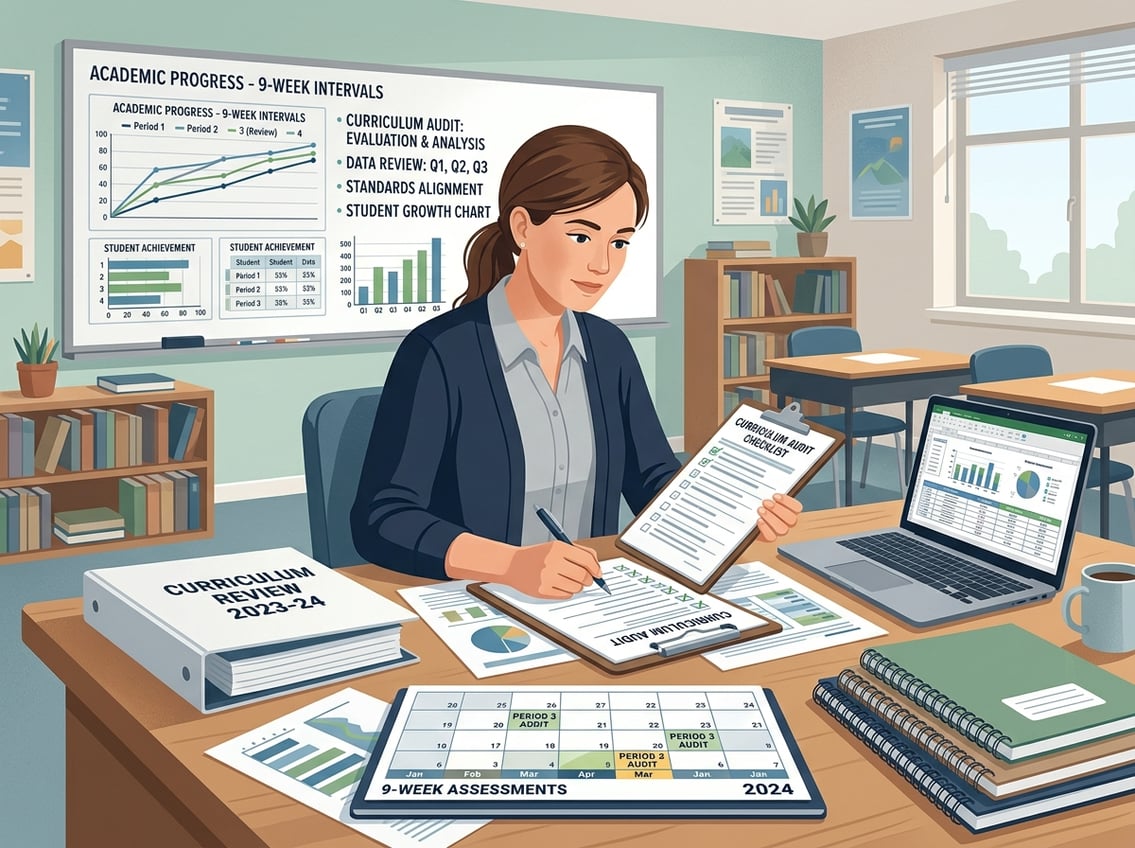
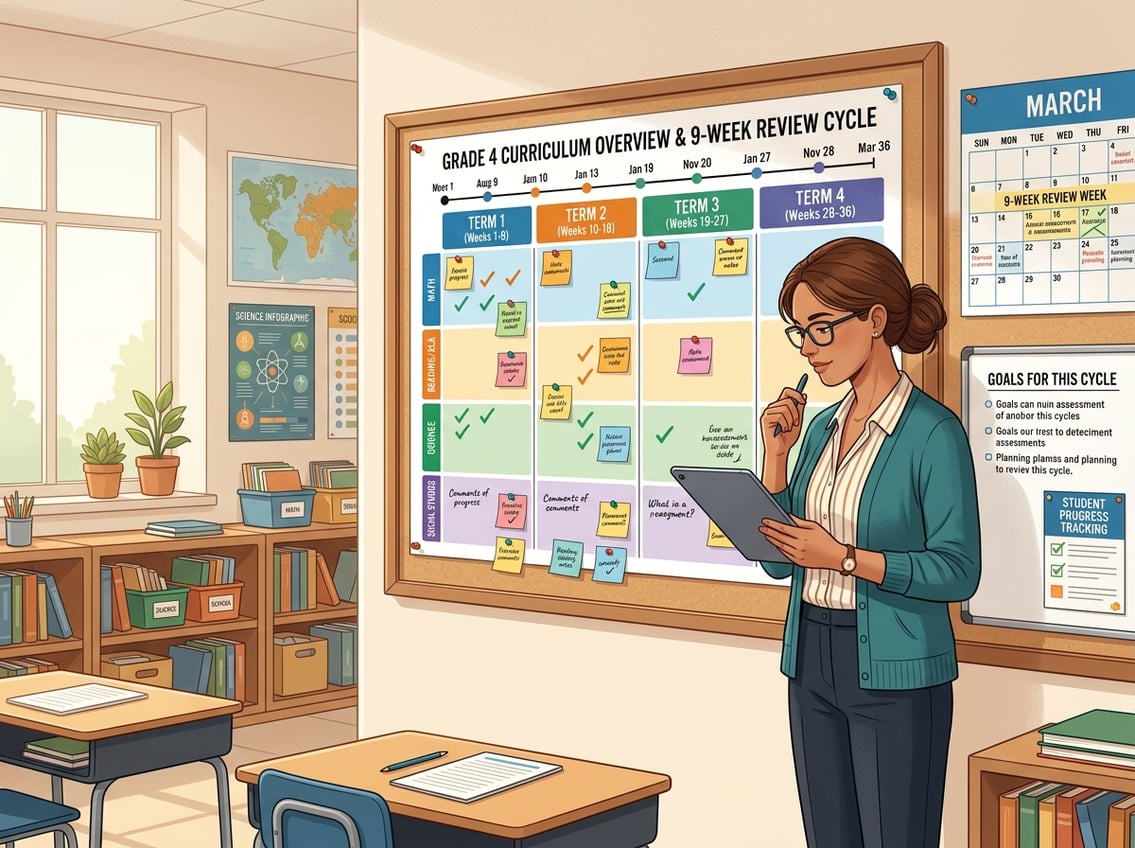
An educator reviewing documents and checking a checklist at a desk with educational materials and a calendar marked every 9 weeks.

A meaningful curriculum audit starts with knowing exactly what you’re looking at and why. Every nine weeks, you should check whether your goals, instruction, and assessments still line up, and whether gaps or overload have quietly crept in.

Define The Scope Before You Review

Before you open a single document, decide what you’re actually reviewing. Are you auditing a single grade level, one subject area, or an entire program?

Setting the scope keeps your review focused and prevents it from turning into an overwhelming project. Pick a narrow focus for your first cycle.

You might choose just your math curriculum for grades 3-5, or a single ELA course. Write down the boundaries so everyone on the team knows what’s included and what’s not.

You can always expand in future cycles.

Compare Goals, Instruction, And Assessment

The core question in any curriculum audit is simple: do your goals, daily instruction, and assessments actually connect? Pull out your stated learning objectives and check whether each one shows up in both your teaching activities and your assessment plan.

If a goal exists on paper but never appears in a lesson or test, that’s a red flag. If an assessment measures something you never explicitly taught, that’s another one.

Conducting a curriculum audit means tracing each goal from start to finish.

Look For Gaps, Overload, And Drift

Over nine weeks, curriculum drift happens easily. Maybe you spent three weeks on a topic that only needed one.

Maybe a key standard got skipped when a snow day or assembly reshuffled your calendar. Check for these patterns:

  • Gaps: Standards or skills that received little to no instructional time
  • Overload: Topics taught repeatedly across units without adding depth
  • Drift: Lessons that wandered away from your original pacing plan

Evidence To Gather Before The Review

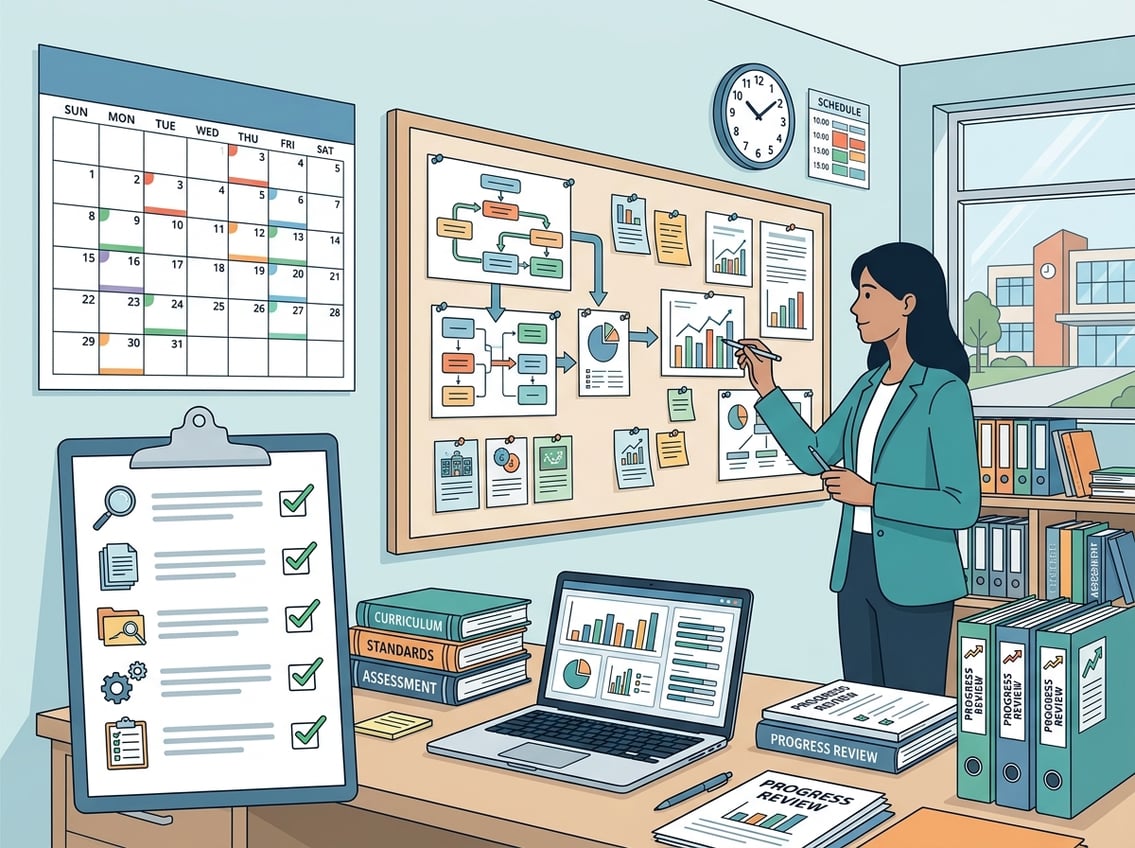
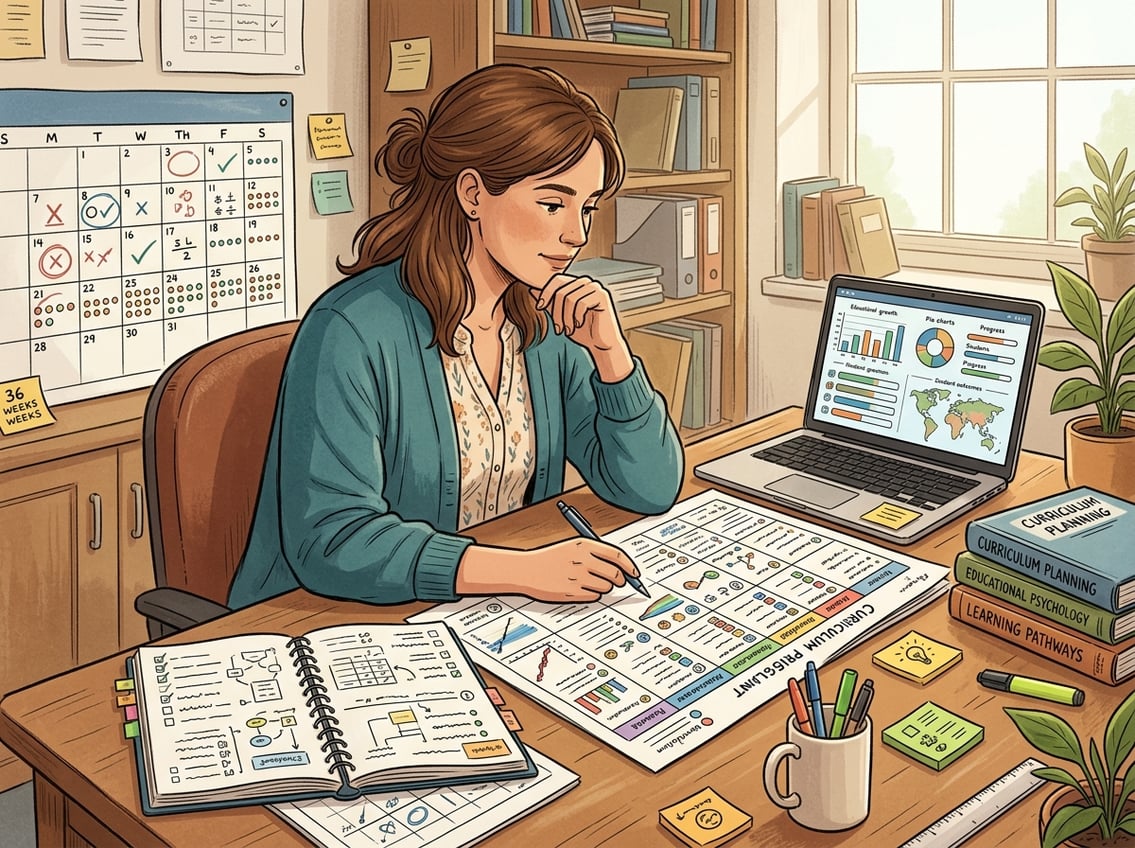
A person reviewing documents and charts at a desk with a calendar and checklist, symbolizing a curriculum audit and progress review process.

Good decisions come from good evidence. Before sitting down for your nine-week review, gather three categories of information: your planning documents, your student performance data, and the curriculum materials teachers actually put in front of students.

Collect Curriculum Maps, Pacing Guides, And Syllabi

Start with the documents that outline what should be happening. Pull together your scope and sequence, pacing guides, unit plans, and any syllabi that describe the intended flow of instruction.

These documents serve as your baseline. You’ll compare them against what actually happened in classrooms.

If your pacing guide says Unit 3 should wrap up by week six, check whether that timeline held. If it didn’t, note why.

Review Student Work And Assessment Trends

Student work tells you what learning actually looked like. Collect a sampling of formative assessments, quizzes, projects, and exit tickets from the past nine weeks.

Look for patterns, not outliers. If 60% of students struggled with the same skill, the issue likely isn’t individual students.

It’s probably an instructional or sequencing problem. Track trends in scores across units to see where performance dropped or spiked unexpectedly.

Examine The Curriculum Materials Teachers Actually Use

There’s often a difference between the adopted curriculum materials and what teachers actually use in daily practice. Some teachers supplement heavily.

Others skip sections they find unhelpful. Ask teachers to share the resources they relied on most during the past nine weeks.

This might include worksheets they created, videos they pulled from outside sources, or textbook chapters they skipped entirely. As noted in the Curriculum Audit Tool from TeachQuill, teams get better results when they review what’s really being taught rather than relying on vague impressions.

Knowing the real materials in play helps you spot alignment issues faster.

How To Run The 9-Week Audit Cycle

A person reviewing documents and charts at a desk with a calendar showing a 9-week timeline and progress tracking visuals around.

Running the audit itself doesn’t need to be complicated. A structured process with clear questions, the right people in the room, and a simple way to record findings keeps the cycle efficient and repeatable.

Set Review Questions And Success Criteria

Before the review meeting, write out three to five specific questions you want to answer. Vague conversations lead to vague conclusions.

Strong review questions look like this:

  • Did students meet the proficiency target for the priority standards taught this quarter?
  • Were all planned units delivered within the pacing window?
  • Which assessments produced data we actually used to adjust instruction?

Define what “good enough” looks like for each question before you start reviewing. If your target is 70% proficiency on priority standards, write that down.

Clear criteria prevent endless debates about whether results are acceptable.

Involve Teachers, Coaches, And Academic Leaders

A curriculum audit shouldn’t be something done to teachers. It should be done with them.

Teachers hold the most accurate picture of what happened in classrooms, while coaches and academic leaders bring a broader perspective on patterns across grade levels or departments. Assign roles before the meeting.

One person facilitates. One person takes notes.

Teachers share their classroom-level observations, and coaches or leaders help connect the dots across teams. Keep the tone collaborative, not evaluative.

Document Findings In A Simple Audit Template

You don’t need fancy software. A shared document or spreadsheet with these columns works well:

Area Reviewed What’s Working What’s Not Evidence Next Step
Unit 2 Pacing Completed on time Assessment scores low 45% proficiency on Unit 2 test Reteach key skills in Week 1
Standards Coverage 8 of 10 standards taught 2 standards not addressed Pacing guide comparison Add standards to Unit 3

Save each cycle’s template. Over time, you’ll build a record that shows whether your changes are making a difference.

How To Judge Alignment And Quality

A person at a desk reviewing documents and charts with folders, a calendar, and educational materials around them.

Alignment and curriculum quality aren’t the same thing, but they’re closely related. A well-aligned curriculum that lacks rigor still falls short.

A rigorous curriculum with poor sequencing confuses students. You need to evaluate both.

Check Mission, Standards, And Sequence Coherence

Start by asking whether your curriculum reflects your school’s or district’s mission. If your mission emphasizes critical thinking but your assessments only test recall, there’s a disconnect.

Next, trace your standards through the sequence. Each standard should build logically from one unit to the next.

Look for places where students are expected to apply a skill they haven’t been taught yet. That’s a sequencing problem, and it shows up as student confusion in the classroom.

Spot Missing Content, Redundancy, And Bias

Use your evidence to flag three specific issues:

  • Missing content: Skills or topics your standards require but your curriculum doesn’t address.
  • Redundancy: Activities that look different on the surface but teach the same skill at the same depth. Repetition for mastery is fine. Accidental repetition wastes time.
  • Bias: Materials that consistently center one perspective or exclude the lived experiences of your student population.

Use Findings To Measure Curriculum Quality

Pull your findings together and score your curriculum quality using simple categories: strong, adequate, or needs attention. Rate each unit or course on alignment, rigor, engagement, and accessibility.

A straightforward rating system helps your team prioritize where to focus improvement efforts during the next nine-week cycle.

Turning Findings Into Action

An educator reviewing a curriculum chart in a classroom, holding a clipboard and surrounded by educational materials and a calendar.

An audit that produces findings but no changes is just paperwork. The real value of your nine-week review comes from what you do next.

Keep your action steps focused, realistic, and directly tied to what the evidence revealed.

Prioritize Fixes For The Next 9 Weeks

You will almost certainly find more issues than you can fix in one cycle. That’s normal.

Pick two to three high-impact changes and commit to those. Ask yourself: which fix will affect the most students?

Which one addresses a problem the data showed most clearly? Start there.

Save lower-priority items for future cycles. Trying to fix everything at once leads to burnout and half-finished improvements.

Update Plans Without Creating Curriculum Creep

When you adjust your plans, resist the urge to keep adding. Every time you insert a new lesson or activity, ask what you’re removing to make room for it.

Curriculum creep happens when well-meaning additions pile up without anything being taken away. Keep your pacing guide realistic.

If a reteach block takes up a week, something else needs to shift. This discipline protects your teachers from an impossible workload and keeps instruction focused.

Feed Audit Results Into Ongoing Curriculum Development

Each nine-week audit should inform your larger curriculum development process. Over three or four cycles, patterns emerge that individual reviews might miss.

Maybe a particular unit consistently underperforms. Maybe teachers always supplement the same chapter with outside resources.

These recurring findings signal that a deeper revision is needed, not just a quick fix. Store your audit templates where curriculum leaders can access them during annual planning.

When it’s time for a full curriculum revision, you’ll have a year’s worth of evidence instead of starting from scratch.

Frequently Asked Questions

A person reviewing a curriculum progress chart with a calendar, notebooks, and a laptop in a study space.

What should I include in a 9-week progress review to make it truly useful?

Include your original learning goals, student assessment data, pacing guide comparisons, and teacher observations about what actually happened in classrooms. The review becomes useful when you compare planned instruction against delivered instruction and measure student outcomes against clear proficiency targets.

How can I tell if my current lessons are actually helping me reach my learning goals?

Look at whether your assessment results align with the skills and standards your lessons were designed to teach. If students consistently score low on a specific standard despite completing related lessons, the lessons may need restructuring.

Match each lesson to a measurable outcome and check whether students are meeting it.

Which data or evidence should I collect over nine weeks to measure real progress?

Gather formative assessment scores, student work samples, pacing guide completion records, and notes on which curriculum materials teachers actually used. Attendance patterns and assignment completion rates also help paint a fuller picture of whether instruction reached students as intended.

What are the best signs that it’s time to adjust or replace parts of my curriculum?

Consistent low performance on specific standards, teachers regularly supplementing or skipping sections, and student disengagement with particular units are strong signals. If the same problems appear across two or more audit cycles, a surface-level fix likely won’t work, and a deeper revision is needed.

How can I set clear, measurable goals for the next nine weeks without overcomplicating it?

Limit yourself to two or three priority goals tied directly to your audit findings. Write each goal with a specific metric, such as “75% of students will score proficient on the Unit 4 assessment.”

Fewer, clearer goals are more actionable than a long list of vague aspirations.

What’s a simple way to turn my review findings into an action plan for the next cycle?

Use a basic template with columns for the issue found, the proposed change, who’s responsible, and the deadline.

Pick only two to three changes per cycle.

Review the template at the start of your next audit to check whether the changes were implemented and whether they made a measurable difference.

Filed Under: Uncategorized

Homeschooling Myths Debunked: What’s Actually True

June 9, 2026 by Valerie Leave a Comment

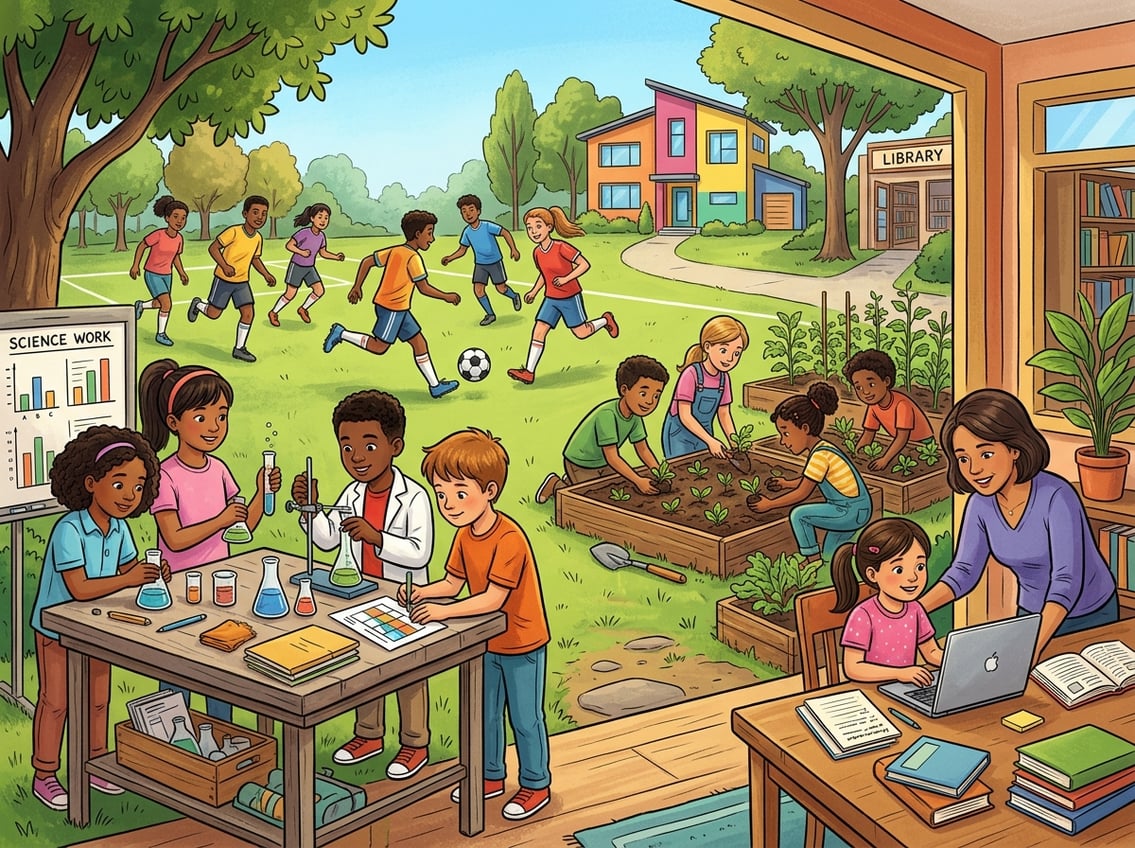
Children and teenagers participating in group activities like science experiments, sports, and gardening with adult guidance in a park and home setting.

Socialization, Activities, And Real-World Readiness

Homeschooled children regularly build social skills through community involvement, extracurricular activities, and everyday interactions with people of all ages.

The idea that learning at home means learning alone simply does not hold up when you look at how homeschool families actually spend their time.

Why Homeschooled Children Are Not Automatically Isolated

The most persistent myth in the homeschooling conversation is that homeschooled students sit alone in a room all day with no contact with the outside world.

This stereotype assumes that socialization only happens inside a school building.

As noted in research on socialization myths and realities, homeschooled kids are far from socially deprived; they simply socialize differently.

Your child’s social life does not depend on a classroom.

Homeschoolers interact with neighbors, participate in community events, and spend time with people across a wide range of ages.

This kind of mixed-age interaction actually mirrors real-world social settings more closely than a room full of same-age peers.

Studies consistently show that homeschooled children perform just as well, and sometimes better, on measures of social development compared to their traditionally schooled peers.

The truth about homeschooling and socialization shows that home-educated students generally adjust well to both social and real-world scenarios.

How Homeschoolers Build Social Skills Through Daily Life

You do not need a school bell schedule to learn how to communicate, cooperate, and resolve conflict.

Homeschooled children develop social skills through everyday life, including family discussions, errands, volunteer work, and conversations with adults in their community.

Because homeschooling offers flexibility, your child has more time for meaningful interactions.

Instead of a rushed 15-minute recess, they can spend an afternoon working alongside a mentor, helping at a local food bank, or simply playing with friends at the park.

These experiences teach adaptability and real communication skills.

Homeschool families also tend to involve children in household decisions and responsibilities earlier.

Cooking, budgeting, and planning family projects together all build the kind of interpersonal skills that matter in adulthood.

Where Extracurricular Activities, Co-Ops, And Field Trips Fit In

If you worry about your child missing out on group experiences, consider how many options exist outside of traditional school walls.

Homeschooling families regularly participate in:

  • Sports leagues and recreational teams
  • Music, art, and drama programs
  • Homeschool co-ops that meet weekly for group classes and projects
  • Science clubs, debate teams, and book groups
  • Field trips to museums, nature centers, and local businesses

Co-ops deserve special attention.

These are communities where homeschool families come together to share resources, plan group activities, and hold classes.

Your child gets the benefit of group learning and teamwork without giving up the flexibility of home education.

Field trips are another major advantage.

Rather than waiting for a single annual school trip, homeschooling families can take frequent, hands-on learning outings.

A Tuesday morning at a botanical garden or a Wednesday afternoon at a fire station becomes part of the regular routine.

These experiences build both knowledge and social confidence in real-world settings.

Learning Quality, Structure, And Academic Progress

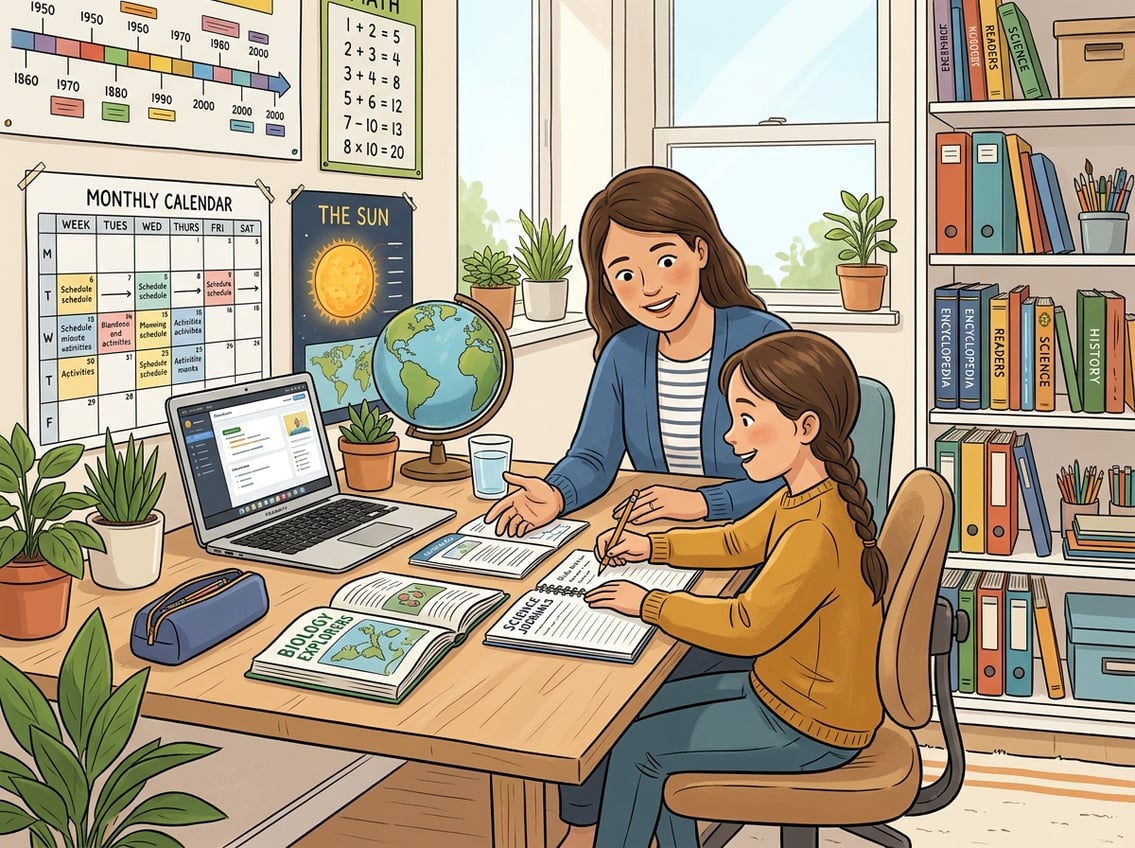
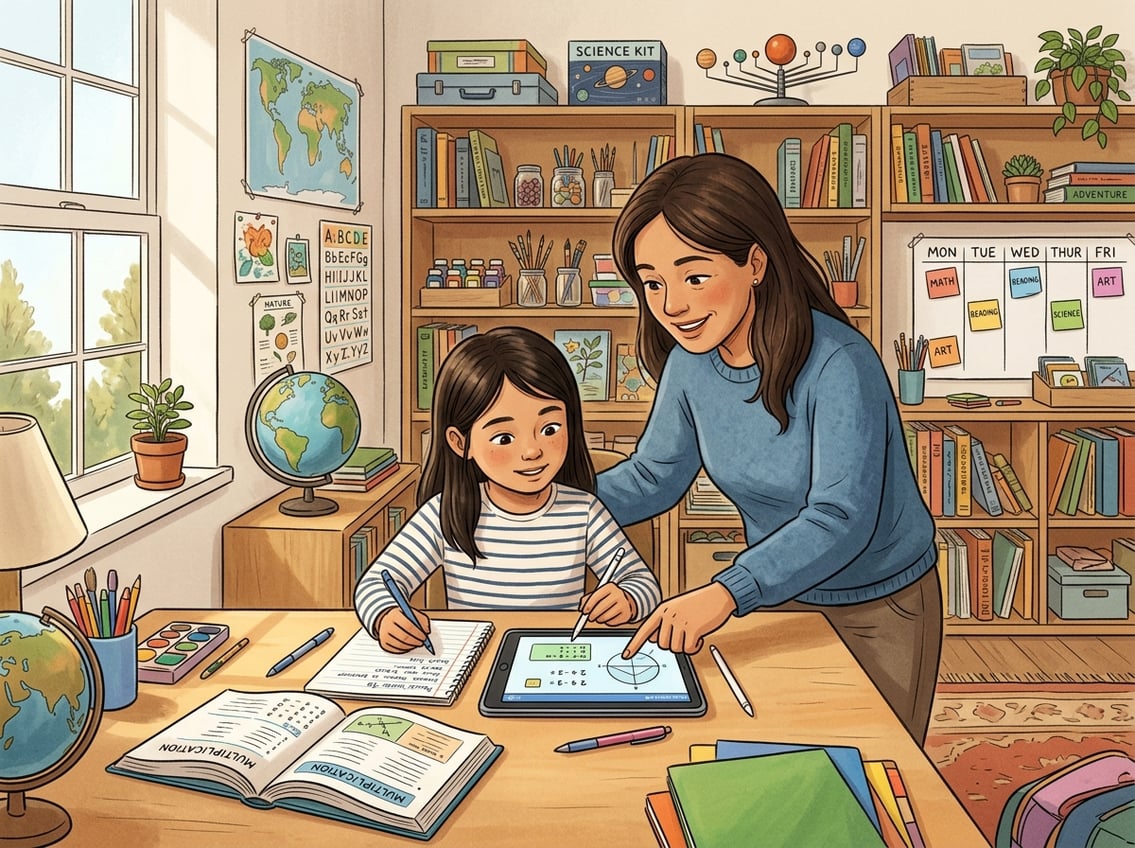
A parent and child studying together at a desk surrounded by books and educational materials in a bright, organized room.

Personalized learning, consistent routines, and measurable academic progress are hallmarks of effective home-based education.

Homeschooling curricula give you the tools to tailor instruction to your child’s pace, while standardized tests and evaluations provide clear benchmarks along the way.

Why Personalized Learning Is A Core Strength Of Home Education

One of the biggest advantages of homeschooling is that you can match the curriculum to your child’s learning style, interests, and speed.

In a traditional classroom, a teacher manages 20 to 30 students at once.

At home, you focus entirely on one learner at a time.

Personalized education means your child can spend more time on difficult subjects and move quickly through material they already grasp.

This approach reduces frustration and keeps motivation high.

Home education also lets you choose from a wide range of teaching methods.

Some families follow classical models that emphasize reading and vocabulary.

Others use project-based learning or hands-on experiments.

With mastery-based learning and structured curricula, homeschool students build strong academic foundations at their own pace.

Personalized learning does not mean lower standards.

It means smarter, more efficient instruction shaped around your child’s actual needs.

The Truth About Self-Discipline, Routine, And Time Management

A common concern is that homeschooled children lack structure.

The reality is that most homeschooling families follow clear daily routines that teach self-discipline and time management from an early age.

Your schedule might not look like a school day, and that is the point.

Many families start academics in the morning, break for lunch and physical activity, then return for reading or creative projects.

Others shift schedules to fit family needs.

The key is consistency, not rigid bell times.

Because homeschool students often manage their own assignments and deadlines, they develop time management skills earlier than many of their peers.

By high school, many homeschoolers already know how to plan a week of work, prioritize tasks, and study independently.

These habits carry directly into college and career settings.

How Homeschooling Curricula And Standardized Tests Measure Progress

You might wonder how to know if your child is keeping up academically.

Homeschooling curricula come with built-in assessments, quizzes, and grade-level benchmarks that help you track progress throughout the year.

Many states also require or offer standardized tests for homeschool students.

These tests provide an objective snapshot of where your child stands in subjects like math, reading, and science.

According to data highlighted in common homeschooling myths research, many families invest in regular evaluations to actively monitor academic progress.

The results are encouraging.

Homeschooled students consistently perform at or above national averages on standardized tests.

A review of academic outcomes confirms that personalized, student-centered learning does not sacrifice rigor.

Instead, it often produces stronger results because instruction is focused and efficient.

Keeping a portfolio of your child’s work, test scores, and completed projects also creates a clear record for college applications and future opportunities.

Who Homeschooling Works For And Why Misconceptions Persist

Families of different backgrounds homeschooling children together in a bright, organized room with books and learning materials.

Homeschooling parents come from every background, education level, and motivation.

The myths about homeschooling that still circulate tend to reflect outdated stereotypes rather than the diverse reality of modern home education.

Why Homeschooling Parents Do Not Need To Be Certified Teachers

One of the most stubborn homeschooling myths is that you need a teaching degree to educate your child at home.

In most U.S. states, there is no requirement for homeschooling parents to hold a teaching certificate.

What you need is dedication, a solid curriculum, and a willingness to learn alongside your child.

As noted by The Homeschooling Company’s myth breakdown, the idea that parents are not qualified is one of the biggest misconceptions holding families back.

In reality, a parent who knows their child’s strengths, weaknesses, and learning style is often better equipped to guide that child than a teacher managing a large classroom.

Plenty of resources exist to support you.

Packaged curricula, online courses, tutoring services, and co-op classes all fill gaps in subjects where you feel less confident.

How Different Homeschooling Families Make It Work

Homeschooling is not limited to one type of family.

Single parents, dual-income households, military families, and families with special-needs children all homeschool successfully.

Some are motivated by religious values, while others choose home education for academic flexibility or safety reasons.

According to Great Homeschool Conventions, the homeschool population includes secular families, families from various faith traditions, and those driven by academic, social, or lifestyle factors.

The stereotype that homeschooling is only for religious or politically motivated families misses this broader picture entirely.

What unites homeschooling families is a shared commitment to their children’s education, not a single demographic profile.

Why Myths About Homeschooling Keep Spreading

Misconceptions persist for a few simple reasons.

Most people went through traditional schools and have no firsthand experience with homeschooling.

Media portrayals often lean on stereotypes.

And well-meaning friends or relatives may repeat concerns they have heard without checking the facts.

As one education analysis points out, many education misconceptions come from people who have never watched parent-led learning in action.

When your only reference point is a traditional classroom, anything different can seem risky.

The best way to combat these myths is with real information.

Homeschoolers consistently demonstrate strong academics, healthy social lives, and readiness for college and careers.

The more families share their experiences openly, the harder it becomes for outdated stereotypes to survive.

Frequently Asked Questions

A family in a cozy home learning environment with a parent helping a child study, surrounded by books and educational materials.

Will my child miss out on socialization if we homeschool?

No.

Homeschooled children socialize through co-ops, sports teams, community groups, field trips, and everyday interactions with people of all ages.

Research shows that homeschoolers develop social skills that match or exceed those of traditionally schooled children because their social experiences tend to be more diverse and intentional.

Is homeschooling only for families with a parent who has a teaching degree?

Not at all.

Most U.S. states do not require parents to hold any teaching certification to homeschool.

You can use structured curricula, online programs, and co-op classes to teach subjects where you need extra support.

Knowing your child and being committed to their education matters far more than a formal degree.

Do homeschooled students perform as well academically as public school students?

Yes.

Homeschool students consistently score at or above national averages on standardized tests.

According to a review of common myths about homeschooling, personalized instruction allows students to master subjects thoroughly before moving on, which often leads to strong academic outcomes.

Can homeschooled students still participate in sports, clubs, and extracurricular activities?

Absolutely.

Many communities offer sports leagues, music programs, drama clubs, and other activities open to homeschoolers.

Some states even allow homeschool students to participate in public school extracurricular programs.

Co-ops and local organizations also provide group activities specifically designed for homeschooling families.

Is homeschooling only for highly religious or politically motivated families?

Homeschooling Family

No. While some families homeschool for religious reasons, the homeschool population is diverse and includes secular families and families of various faiths.

Many families are also motivated by academic goals, travel lifestyles, or special learning needs. There is no single profile of a homeschooling family.

What did Charlie Kirk say about homeschooling, and is it accurate?

Image of homeschooling

Charlie Kirk has publicly encouraged families to consider homeschooling as an alternative to public education.

He often cites concerns about curriculum content and political influence in schools.

While his support for parental choice in education aligns with the legal right to homeschool, some of his broader claims about public schools reflect personal political views rather than universal facts.

Filed Under: Uncategorized

What a Typical Homeschool Day Really Looks Like

June 9, 2026 by Valerie Leave a Comment

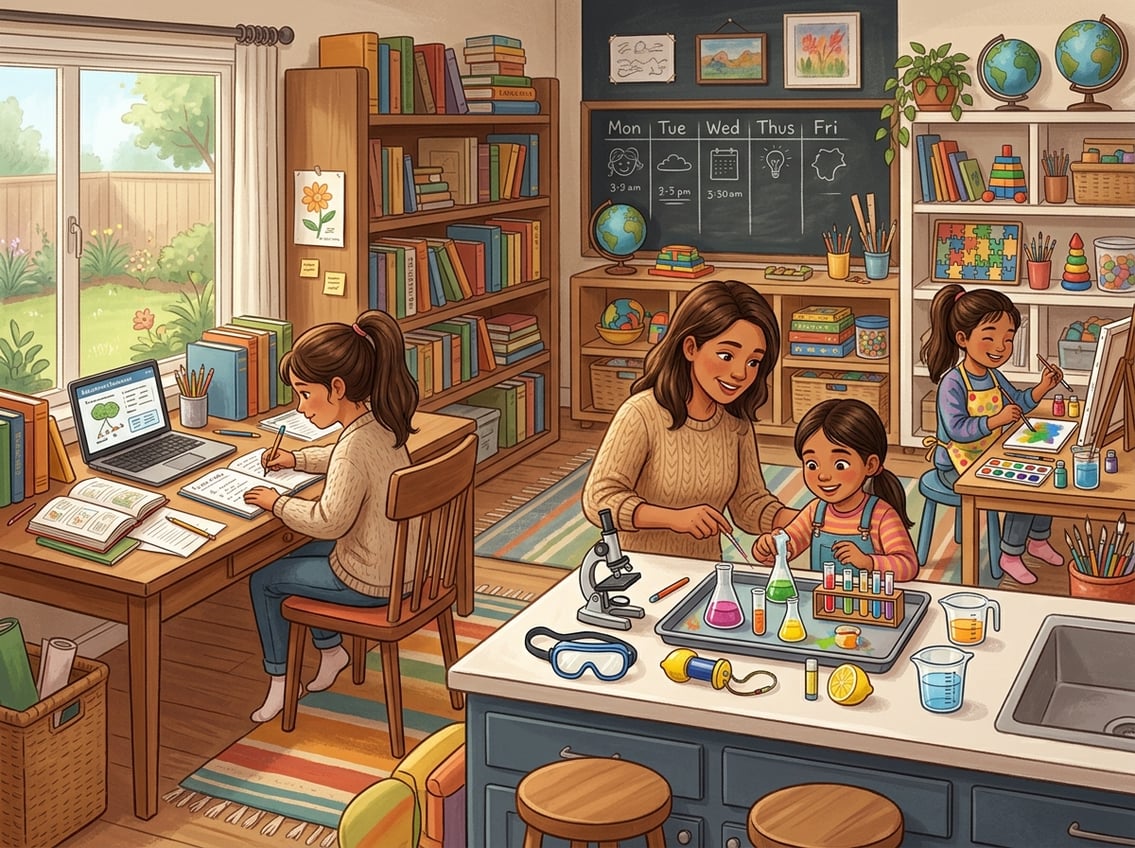
A parent and child engaged in different learning activities at home, including reading, science experiments, and art projects in a cozy room with books and educational materials.

How The Day Usually Flows

Most homeschool families spend far fewer hours on formal academics than you might expect. The rhythm of the day tends to center on core subjects in the morning with looser learning woven into the rest of the day.

What Most Families Mean By Typical

When homeschooling families talk about a “typical” day, they rarely mean a rigid bell schedule. They mean a repeatable rhythm that gives the day some structure without mimicking a traditional classroom.

Your homeschool routine might follow a general flow: morning time together, focused lessons, a break, then independent work or projects. Some families follow a structured homeschool day with set times for each subject, while others use a flexible loop schedule and pick up where they left off the day before.

Both approaches count as “typical” because what matters is consistency, not rigidity.

How Long Formal Learning Usually Takes

One of the biggest surprises for new homeschool families is how little time formal instruction actually requires. According to experienced homeschool parents, elementary students often need only 1.5 to 2 hours of focused schoolwork per day, while middle schoolers typically need 3 to 4 hours.

High school students may spend 5 or more hours, especially if they are working through more demanding coursework. One-on-one instruction is simply more efficient.

You are not waiting for a class of 25 students to settle down. There is no time lost to hallway transitions, attendance, or busywork.

Your child gets direct teaching tailored to their pace.

Why Core Work Often Happens First

Most homeschool families tackle core academics like math, reading, and writing first thing in the morning. The reason is practical: your child’s focus and energy are usually highest early in the day.

Knocking out the hardest subjects while everyone is fresh means the rest of the day feels lighter. If something unexpected comes up in the afternoon, you already have the essentials covered.

This approach turns your homeschool schedule into something that protects priorities rather than fighting against the clock.

What Filling The Hours Actually Looks Like

A parent helping two children with learning activities at a table inside a cozy home filled with books and educational materials.

Beyond formal lessons, homeschool families fill the day with read-alouds, hands-on projects, nature exploration, and practical life skills. Everyday moments become real learning.

Morning Time, Read-Alouds, And Focused Lessons

Many homeschool families start the day with “morning time” or a family gathering. This is when you might read aloud from a living book, recite poetry, discuss a Bible passage, or review something from history together.

It sets a calm, connected tone before anyone opens a textbook. After morning time, you move into focused lessons.

This is where subjects like math, copywork, creative writing, and grammar get direct attention. Your child works one-on-one with you or follows an independent assignment at their level.

These focused blocks are usually the most structured part of the day. Read-alouds often continue beyond morning time, too.

Some families read aloud during lunch or at bedtime, weaving stories and discussions into the family’s rhythm.

Breaks, Independent Work, And Family-Style Learning

Breaks are not wasted time. They are essential.

Sending your kids outside to play for 20 or 30 minutes between subjects helps them reset and come back ready to focus. Independent work looks different depending on age.

An older child might read a history chapter and write a narration on their own. A younger child might practice handwriting or work through a simple math page while you help a sibling.

Family-style learning is a favorite strategy among homeschool families with multiple children. You study the same topic together, like a period in history or a nature study subject, but each child engages at their own reading level.

Then everyone comes together to discuss what they learned.

Afternoons For Projects, Nature, And Life Skills

Afternoons in most homeschool homes look nothing like a classroom. This is when handicrafts, science experiments, art projects, and nature study tend to happen.

You might take a walk to observe birds and sketch them in a nature journal. Your child might learn to cook a simple meal, fold laundry, or repair something around the house.

These are real life skills that matter. Many families also use afternoon hours for music practice, sports, or free reading.

This unstructured time is not wasted. It is where curiosity leads to deeper learning without a lesson plan attached.

Why No Two Homes Run The Same Way

A family homeschooling with a parent helping two children at a table filled with books and art supplies in a cozy living room.

Your family’s ages, outside commitments, and educational philosophy all shape what your homeschool day looks like. No single template fits everyone.

Age, Independence, And Teaching Multiple Children

A five-year-old needs you sitting right beside them. A twelve-year-old can often manage a checklist of assignments independently.

When you are teaching multiple children, you quickly learn to stagger your time. Work directly with one child while another reads or completes independent practice.

Family-style subjects like history, science, and nature study help you teach everyone at once. Children can all study the same time period but read books at their own comprehension level and then come together to discuss.

Older children can also reinforce their own learning by helping younger siblings with reading or math facts.

Co-Ops, Outside Activities, And Off-Site Days

Many homeschool families participate in a homeschool co-op one day per week. Co-ops bring families together so kids can take group classes like science labs, drama, public speaking, or PE.

These days look completely different from a regular home day. Outside activities also shape your weekly schedule.

Your child might have a music lesson on Tuesday, a park day with other homeschoolers on Wednesday, and a sports practice on Thursday. Some families dedicate one full day to co-op and scatter individual classes throughout the week.

Your routine flexes around these commitments.

Flexible Approaches From Routine To Unschooling

Some families thrive with a detailed written schedule. Others prefer a loose rhythm where subjects happen in a general order but without fixed times.

Still others embrace unschooling, where the child’s interests and questions drive the learning rather than a set curriculum. Your routine depends on your kids’ ages, how many you are teaching, and what your everyday life looks like.

There is no single “right” way. The best homeschool day is one that fits your family.

Frequently Asked Questions

A child studying at a desk with a parent guiding them in a bright, organized home learning space filled with books and educational materials.

How many hours a day do families typically homeschool?

Most families spend between 2 and 5 hours on formal schoolwork each day, depending on the child’s grade level. Elementary-age children often finish in under 2 hours, while high schoolers may need 5 hours or more.

The total is much shorter than a traditional school day because one-on-one instruction eliminates time lost to transitions and classroom management.

What time do homeschoolers usually start and finish their school day?

There is no required start time. Many families begin formal lessons between 8:00 and 9:30 in the morning.

Younger students are often finished by late morning or lunchtime. High schoolers may work into the early afternoon.

Most families wrap up structured academics well before a traditional school day would end.

What does a typical homeschool schedule look like by grade level?

In the early grades, you might spend 30 minutes on math, 20 minutes on reading, and 15 minutes on handwriting or phonics before moving to read-alouds or play. Middle schoolers add subjects like writing, science, and history, filling 3 to 4 hours.

High schoolers often follow a more independent schedule with longer study blocks and elective coursework.

What does a homeschool day look like for kindergarten students?

Kindergarten homeschooling is short and play-based. You might spend 15 to 20 minutes on a phonics lesson, another 15 on a simple math activity, and then fill the rest of the morning with read-alouds, art, outdoor play, and hands-on exploration.

Formal instruction at this age rarely exceeds an hour.

How is a typical homeschool day different for high school students?

High schoolers take on more responsibility and independence. They often work from a checklist or syllabus, completing reading assignments, essays, and lab work on their own.

Some also attend co-op classes, take dual-enrollment college courses, or follow online curriculum, which adds structure and variety to their week.

How do families balance curriculum, breaks, and extracurriculars during the day?

Homeschool Schedule

Most families prioritize core subjects in the morning.

They schedule breaks between lessons.

Afternoons are often reserved for extracurriculars like sports, music, or co-op activities.

Building flexibility into your daily plan helps you adjust when unexpected events come up without losing momentum on important subjects.

Filed Under: Uncategorized

  • « Go to Previous Page
  • Page 1
  • Page 2
  • Page 3
  • Page 4
  • Page 5
  • Interim pages omitted …
  • Page 24
  • Go to Next Page »

Primary Sidebar

Free Photo Lessons for Kids

Photo Lessons for kids

Categories

  • Photography
  • Preschool
  • Reading
  • Uncategorized
A child and parent working together on a science experiment at home using materials from a subscription box in a bright, organized study area.

Subscription Boxes As Curriculum: What Actually Works

Can A Monthly Kit Count As Real Curriculum? The honest answer is: it depends entirely on what … [Read More...] about Subscription Boxes As Curriculum: What Actually Works

A parent and child reviewing homeschool books together in a cozy study area with shelves of used educational materials and a tablet showing an online marketplace.

How To Buy And Sell Used Homeschool Curriculum On A Budget

Choose Materials With Savings In Mind The curriculum you pick determines how much you can save when … [Read More...] about How To Buy And Sell Used Homeschool Curriculum On A Budget

An illustration showing two classrooms side by side: one where students focus deeply on one math topic with a teacher's guidance, and another where students work on multiple math topics repeatedly in a spiral pattern.

Mastery Vs. Spiral Math: Choosing The Right Fit

How The Two Approaches Differ In Real Lessons The difference between spiral math and mastery math … [Read More...] about Mastery Vs. Spiral Math: Choosing The Right Fit

Students taking tests in a classroom while a teacher observes and takes notes, with visual symbols of timing and decision-making around them.

Curriculum Placement Tests: When and How to Use Them Well

What Placement Tests Tell You and When to Use Them Placement tests and standardized tests serve … [Read More...] about Curriculum Placement Tests: When and How to Use Them Well

A teacher reviewing a detailed curriculum planner spread out on a desk with educational tools around.

Scope and Sequence Explained: A Practical Planning Guide For Curriculum Planning

What Scope and Sequence Means in Real Curriculum Planning A scope and sequence is one of the most … [Read More...] about Scope and Sequence Explained: A Practical Planning Guide For Curriculum Planning

A family sitting at a kitchen table surrounded by homeschooling supplies, receipts, and a laptop, discussing and planning their homeschooling budget.

The Hidden Costs of Homeschool Curriculums and Smart Budgeting

What Families Actually Pay Beyond Curriculum The sticker price of a homeschool curriculum rarely … [Read More...] about The Hidden Costs of Homeschool Curriculums and Smart Budgeting

A parent and child working together at a table with books and a laptop in a bright room, with a bulletin board displaying charts and papers in the background.

How To Align Your Homeschool Curriculum With State Standards

What "Aligned To Standards" Actually Means At Home Standards alignment in homeschooling is not … [Read More...] about How To Align Your Homeschool Curriculum With State Standards

A parent and child working together on a homeschool lesson using a tablet with AI assistance in a bright study area.

Using AI To Enhance Your Homeschool Curriculum With ChatGPT

Build Customized Lessons With ChatGPT First ChatGPT can help you build a homeschool curriculum that … [Read More...] about Using AI To Enhance Your Homeschool Curriculum With ChatGPT

A group of children and adults of different ages working together around a table with educational materials in a bright learning space.

Family-Style Curriculums For Teaching Multiple Ages At Once

What Makes A Curriculum Work Across Multiple Ages A strong family-style homeschool curriculum saves … [Read More...] about Family-Style Curriculums For Teaching Multiple Ages At Once

A group of young people using digital devices surrounded by symbols of coding and computer science in a modern learning environment.

Coding And Computer Science: Best Curriculums Reviewed

How To Choose The Right Learning Path First Your child's age, current skill level, and long-term … [Read More...] about Coding And Computer Science: Best Curriculums Reviewed